



Review Us On Google
Call Us Now
312-CHI-CAGO

100% Customer
Satisfaction

Review Us On Google
Chicago skyline

Author Archive

Chicago High-Rise Office Move Guide

Chicago High-Rise Office Moving Guide: Requirements, Checklist & Planning Tips

Chicago High-Rise Office Moving Guide: Requirements, Checklist & Planning Tips

Moving into a Chicago high-rise office requires more coordination than a typical commercial move. Before moving day, your business may need to reserve a freight elevator, schedule loading dock access, provide a certificate of insurance (COI), obtain building management approval, coordinate security access, verify truck parking, and work within strict move-in hours.

The most important rule is simple: confirm your building's moving requirements before scheduling the final move date. Rules can vary significantly between downtown Chicago office towers, even when the buildings are only a few blocks apart.

Chicago Office Movers regularly handles the logistics involved in commercial relocations, including move management, furniture disassembly and reassembly, IT and server-room relocations, and moves involving union properties.

Chicago High-Rise Office Moving Checklist

Before moving into a Chicago high-rise, confirm these items:

  • Contact building or property management
  • Get the building's move-in requirements in writing
  • Reserve the freight elevator
  • Reserve the loading dock or service entrance
  • Confirm permitted moving dates and hours
  • Obtain the required certificate of insurance
  • Verify truck size and loading restrictions
  • Determine whether parking or curb permits are needed
  • Confirm security and contractor check-in procedures
  • Ask whether union labor is required
  • Measure elevator doors, elevator cabs, hallways and suite entrances
  • Measure oversized office furniture
  • Coordinate furniture disassembly if needed
  • Schedule IT shutdown and restart
  • Confirm floor, wall and elevator protection requirements
  • Create a move-day access plan
  • Give your moving company the building manager's contact information
Key takeaway: Build your moving schedule around the building's access window rather than scheduling the building around the movers.

Why Is Moving Into a Chicago High-Rise Different From a Regular Office Move?

The biggest challenge with a high-rise office move usually isn't transporting the furniture. It's working around everything the building controls.

A suburban office move may allow a moving truck to pull close to an entrance while crews work relatively freely. In a downtown Chicago high-rise, movers may instead have to coordinate around:

  • Shared freight elevators
  • Limited loading dock space
  • Other tenant moves
  • Deliveries and contractors
  • Building security
  • Restricted moving hours
  • Service corridors
  • Elevator weight and size limits
  • Lobby restrictions
  • Floor and wall protection requirements

A loading dock may only accommodate one or two trucks at a time. Security may require the names of every crew member before they arrive. Some properties only permit major moves during evenings or weekends.

Even the route between the loading dock and your office suite can affect the moving plan.

Is Your Chicago Office Building a Union Building?

Some downtown Chicago properties require union labor for certain moving work.

Ask building management about union requirements before selecting or scheduling a moving company. The requirement can affect which crews are permitted to work inside the property and how the move must be scheduled.

Chicago Office Movers is a member of Teamsters Local 705 and can handle relocations in properties where union moving labor is required.
Chicago Union Movers Infographic

Do You Need to Reserve a Freight Elevator for a Chicago Office Move?

In many Chicago high-rise buildings, yes. Tenants are commonly required to reserve a freight elevator for a move, and some properties restrict furniture and moving equipment from passenger elevators. Freight elevators are better suited for office relocations because they typically offer:

  • Larger elevator cabs
  • Wider doors
  • Higher weight capacities
  • Protective padding
  • Access to service corridors
  • Better access to loading areas

Reservations are generally handled through building or property management. A commercial moving company providing move management can often help coordinate the process.

What Should You Ask Before Reserving a Freight Elevator?

Ask building management:

  • How far in advance does the freight elevator need to be reserved?
  • What moving hours are available?
  • Is the elevator dedicated to our move?
  • Will it be shared with other tenants?
  • What are the cab dimensions?
  • What is the elevator's weight capacity?
  • What is the width and height of the elevator door?
  • Is elevator padding required?
  • Who provides the padding?
  • Is floor protection required?
  • What happens if the move exceeds the reserved time?
  • What is the contingency plan if the elevator is unavailable?
Chicago office moving tip: Get the elevator's door-opening dimensions, not just the interior cab measurements. A large conference table may technically fit inside the elevator but still be unable to pass through the door.

How Does Loading Dock Access Work for a Chicago High-Rise Move?

Loading dock access can be one of the biggest logistical constraints during a downtown Chicago office move.

Before scheduling trucks, confirm:

  • Whether the building has a dedicated loading dock
  • Whether dock reservations are required
  • How long a truck can remain in the dock
  • Maximum truck length
  • Maximum vehicle height
  • Dock clearance
  • Whether a liftgate is necessary
  • Loading dock operating hours
  • Whether dock staff must be present
  • Where additional moving trucks can stage

Not every Chicago high-rise has a traditional loading dock. Some buildings use an alley service entrance. Others rely on a designated loading area or another approved access point.

If there is no dedicated loading dock, the move may require a longer carry between the truck and freight elevator, which can affect labor needs, crew size and the amount of time required for the move.

Do You Need a Certificate of Insurance for a Chicago Office Move?

Many commercial office buildings require a moving company to provide a certificate of insurance, commonly called a COI, before movers are permitted to enter the property.

Requirements differ by building, so obtain the exact insurance specifications directly from property management.

A moving-company COI commonly documents coverage such as:

  • General liability
  • Automobile liability
  • Workers' compensation
  • Umbrella or excess liability when required

The building may also require specific parties to be listed as additional insureds.

Who Provides the COI?

The moving company's insurance carrier or broker normally prepares the certificate based on the building's requirements.

When Should You Submit the COI?

Submit it as early as practical after receiving the property's requirements. Some buildings require insurance documentation well before move day.

What Can Go Wrong With a COI?

One of the most common issues is not simply forgetting the certificate. It is submitting a COI with:

  • The wrong legal entity
  • Incorrect additional insured wording
  • Insufficient coverage limits
  • Incorrect property information
  • Expired coverage

Ask building management for its exact requirements and, when available, a sample certificate.

A missing or incorrect COI can delay approval for freight elevator or loading dock access.

What Should You Ask the Building Manager Before an Office Move?

Before finalizing your moving date, ask:

  • What dates and hours are moves permitted?
  • Are weekend moves allowed?
  • Are after-hours moves required?
  • Are there after-hours building fees?
  • Do we need to reserve a freight elevator?
  • How long can we reserve the elevator?
  • Is a certificate of insurance required?
  • What insurance limits are required?
  • Who needs to be listed as an additional insured?
  • Is a loading dock available?
  • How long can a truck remain in the loading dock?
  • Are there restrictions on truck height or length?
  • Are there move-in fees or deposits?
  • Does security need a moving crew list?
  • What identification do movers need?
  • Is floor or wall protection required?
  • Are there restrictions on using the lobby?
  • Is union labor required?
  • Where can moving trucks stage?
  • Who is the building contact on move day?

Also request the move-day contact's direct phone number. If an access issue occurs during an evening or weekend move, a direct building contact can be much more useful than a general property-management number.

What Is a High-Rise Office Move Window?

A move window is the period during which a building permits moving activity. For example, an office tower may allow moves:

  • After regular business hours
  • During designated evening hours
  • On Saturdays
  • On Sundays
  • During specific loading-dock windows

Buildings establish move windows to reduce interference with employees, visitors, deliveries and other tenants.

Are Weekend Office Moves Better?

Not necessarily. Weekend moves can reduce interference with employees, but they may also involve:

  • Additional building fees
  • Reduced building staff
  • Special security arrangements
  • Limited freight elevator availability
  • Different loading dock procedures

The best schedule depends on the building, freight elevator availability, downtown traffic, the size of the relocation and how much business downtime you can tolerate.

Where Can Moving Trucks Park During a Downtown Chicago Office Move?

Do not assume a commercial moving truck can park directly outside your building.

Downtown Chicago curb space can be restricted, metered, signed or otherwise unavailable. Depending on the property, moving trucks may need to use:

  • A loading dock
  • Alley access
  • A service drive
  • An approved loading zone
  • Reserved curb space

Some moves may require permits or other arrangements when public curb space, sidewalks or the public right-of-way are involved.

Because City of Chicago permitting requirements and fees can change, verify current requirements with the appropriate city department, 311, building management or your commercial moving company before move day.

What Security Information Is Needed Before Moving Into a High-Rise?

Properties with controlled access may require moving-company and vehicle information before move day. Be prepared to provide:

  • Moving company name
  • Crew member names
  • Driver information
  • Truck information
  • Moving date
  • Approved moving hours
  • Freight elevator reservation
  • Loading dock reservation
  • Tenant contact information
  • Required insurance documents

On moving day, crews may need to check in with building security, provide identification and use designated service entrances or access cards.

After-hours moves may have additional procedures, so confirm them before the crew arrives.

Measure the Freight Elevator and Furniture Before Moving Day

A desk fitting inside your current office doesn't mean it will fit through the elevator doors at your new building. Before moving day, measure:

  • Freight elevator door
  • Freight elevator cab
  • Suite entrance
  • Building doors
  • Service corridors
  • Hallways
  • Tight corners
  • Stairways

Then measure large office items, including:

  • Conference tables
  • Reception desks
  • Executive desks
  • Large file cabinets
  • Server racks
  • Storage cabinets
  • Modular workstations

If an item cannot pass through the planned route, possible solutions include disassembly, using another access route, temporarily storing the item or replacing it.

Large conference tables and reception desks frequently require special planning because they may originally have been assembled inside the office.

Read our guide to furniture disassembly before an office move

How Should IT Be Coordinated During a High-Rise Office Move?

IT relocation needs to follow the same master schedule as the movers and building.

Computers, servers, network equipment, printers, monitors and phones have to be disconnected, transported and restarted in an order that minimizes business disruption.

A common problem is a mismatch between the IT schedule and building access.

For example, if your IT team cannot shut down critical systems until 6:00 p.m., but the moving company's dock access ends at 8:00 p.m., the available relocation window becomes extremely tight.

Your:

  • Moving company
  • IT provider
  • Building manager
  • Internal move coordinator

should all work from the same timeline.

For larger technology relocations, see our server room and data center relocation services.

Chicago High-Rise Office Move Timeline

2–4 Weeks Before the Move

Contact property management for both buildings and confirm move requirements.

Complete items such as:

  • COI submission
  • Freight elevator reservation
  • Loading dock reservation
  • Moving-hour approval
  • Building fees
  • Union requirements
  • Parking and truck access
  • Security procedures

For larger or more complicated relocations, begin planning earlier.

1 Week Before the Move

Finalize:

  • Moving crew
  • Truck schedule
  • Furniture inventory
  • Office floor plan
  • Employee communication
  • Security list
  • Dock arrangements
  • IT schedule
  • Furniture labels

Label furniture, workstations and boxes according to the new floor plan.

Moving Day

The moving crew should:

  • Check in with building security.
  • Confirm dock or curb access.
  • Install required floor, wall and elevator protection.
  • Confirm the freight elevator.
  • Load and transport office contents.
  • Deliver items according to the floor plan.
  • Reassemble designated furniture.

A company representative should remain available throughout the relocation in case the building or moving crew needs an immediate decision.

After the Move

Complete:

  • Furniture reassembly
  • IT restart
  • Workstation setup
  • Removal of packing materials
  • Damage inspection
  • Old-office walkthrough
  • Final landlord requirements

Common Chicago High-Rise Moving Problems and How to Prevent Them

ProblemHow to Prevent It
Freight elevator wasn't reservedReserve it as soon as the move date is approved and get confirmation in writing.
COI is incorrectObtain the building's exact insurance requirements before requesting the certificate.
Moving truck cannot access the dockConfirm truck length, height, and dock restrictions beforehand.
Furniture doesn't fit in the elevatorMeasure the elevator door and oversized furniture before moving day.
Move is scheduled outside approved hoursVerify permitted moving hours before booking the move.
Security doesn't have the crew listSubmit mover and vehicle information in advance.
Move exceeds the reserved windowBuild crew size and truck scheduling around the available access time.
IT isn't ready when movers arriveCreate one coordinated moving and technology schedule.
Building requires union laborVerify labor requirements before hiring the moving company.

Chicago High-Rise Office Move Requirements

RequirementWhy It MattersWho to Contact
Freight elevatorControls movement between floorsBuilding management
Loading dockDetermines truck accessProperty management
COIMay be required before movers receive accessBuilding + moving company
Move windowDetermines when relocation work can occurBuilding management
SecurityControls vendor and crew accessBuilding security
Parking/loadingDetermines where moving trucks can stopBuilding / applicable city authority
Furniture dimensionsPrevents access problemsMoving company
IT scheduleHelps reduce downtimeIT team + movers
Union requirementsDetermines permitted moving laborProperty management

High-Rise Office Moving in the Loop, River North, West Loop and Downtown Chicago

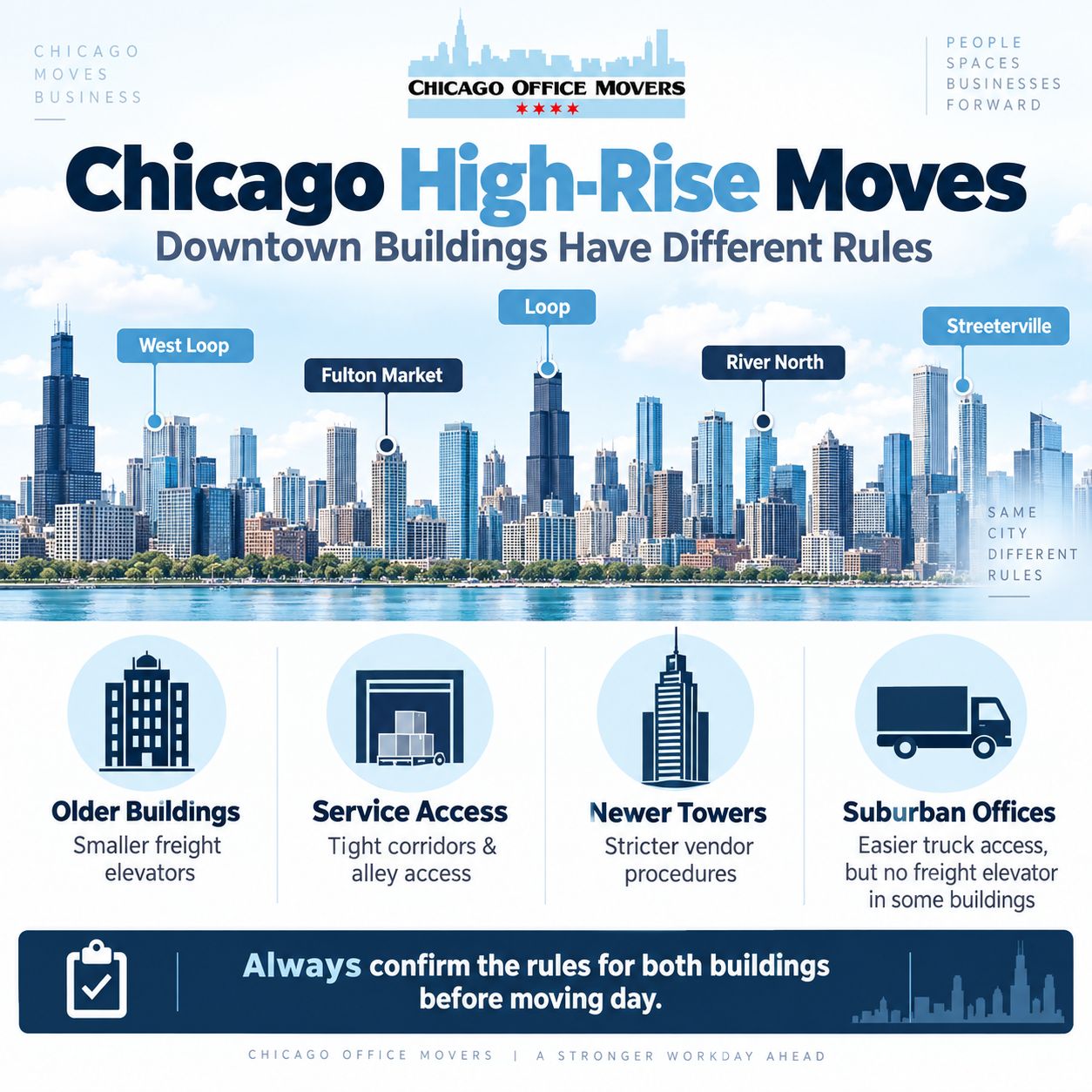
Office-moving requirements can vary throughout the Loop, River North, West Loop, Fulton Market, Streeterville and other downtown Chicago business districts.

Older office buildings may have smaller freight elevators, narrow service corridors or limited alley access. Newer towers may have detailed vendor procedures, dedicated loading schedules or stricter building-access rules.

Suburban office buildings can present a different set of challenges. Truck access may be easier, but some properties do not have freight elevators or formal loading docks.

There is no universal Chicago high-rise moving policy.

Always confirm the requirements for the specific property you're moving into and the building you're leaving.
Chicago High Rise Movers

Chicago High-Rise Office Moving FAQs

How far in advance should I schedule a Chicago high-rise office move?

For many office relocations, beginning planning approximately four to eight weeks ahead provides time to coordinate building requirements, movers, IT and employees. Larger relocations or buildings with limited moving windows may require significantly more lead time.

Do I need to reserve a freight elevator for an office move?

Many Chicago high-rise buildings require freight elevator reservations. Contact property management as soon as the moving date is being considered.

Do Chicago office buildings require a certificate of insurance?

Many commercial properties require a COI from the moving company, but coverage requirements vary by property. Ask building management for the exact limits and additional insured wording.

Can an office move take place on a weekend?

Often, but the building must allow it. Weekend or after-hours moves can require additional security arrangements, fees or building approval.

Can a moving truck park directly outside a Chicago high-rise?

Not necessarily. Depending on the property, movers may use a loading dock, alley, service entrance or approved curb space. Confirm truck access before move day.

What happens if office furniture doesn't fit in the freight elevator?

The moving company may need to disassemble the furniture, find another approved route, temporarily store it or discuss replacement options. Measuring large items and elevator openings beforehand helps avoid that decision on moving day.

What does building management typically need before an office move?

Requirements vary, but commonly requested information includes the moving date, approved moving window, moving-company information, COI, freight-elevator reservation, dock arrangements, crew information and a tenant contact.

How long does a Chicago high-rise office move take?

The timeline depends on the size of the office, number of floors, elevator availability, loading restrictions, furniture requirements and IT needs. Some smaller or mid-sized relocations can be completed within one approved evening or weekend move window, while larger projects may require multiple phases.

What if the building doesn't have a loading dock?

Movers may use an approved service entrance, alley or other loading location. A longer carry between the truck and building can require additional labor and time.

Can commercial movers work after normal business hours?

Yes. Some downtown buildings actually prefer or require substantial moving activity to occur after normal tenant hours.

Who reserves the freight elevator?

The tenant is generally responsible for complying with building requirements, although a commercial moving company providing move management can help coordinate reservations with property management.

How do I know whether my Chicago office building requires union movers?

Ask the building manager or property-management company directly. Determine labor requirements before hiring and scheduling your movers.

Planning a Move Into or Out of a Chicago High-Rise?

A successful Chicago high-rise office move starts with the building requirements, not the moving truck.

Before finalizing the move date, confirm:

  • Freight elevator access
  • Loading dock access
  • Move-in hours
  • COI requirements
  • Security procedures
  • Truck access
  • Union requirements
  • Building protection requirements
  • Parking or permitting requirements

Once those details are confirmed, your moving company can build a realistic plan around the available building window, including crews, trucks, furniture handling, IT coordination and delivery sequencing.

Chicago Office Movers provides commercial move management, furniture disassembly and reassembly, server and data center relocation and moving services for union properties.


If you're planning an office move into or out of a Chicago high-rise, contact Chicago Office Movers to discuss your building's requirements and create a move plan before moving day. Call 312-244-2246 or request a free office moving proposal. You can also use our commercial moving checklist to start planning your relocation.

Contact Us

  • This field is for validation purposes and should be left unchanged.
  • MM slash DD slash YYYY
Best Chicago Neighborhoods to Relocate Your Office in 2026

Best Chicago Neighborhoods to Relocate Your Office in 2026

Best Chicago Neighborhoods to Relocate Your Office in 2026

Key Summary

Chicago's best office neighborhoods in 2026 depend on what a business needs most. Fulton Market is best for companies recruiting tech and creative talent, with the tightest office vacancy in the city at 10.9%. West Loop suits growing companies that need more space at a similar premium. River North offers the best downtown transit access and fits client-facing agencies. The Loop remains the top choice for law, finance, and institutional business. Companies with suburban-commuting teams often choose Oak Brook, Deerfield, or Evanston for lower cost and easier parking.

If you're trying to figure out where in Chicago to put your next office, the answer depends less on which neighborhood sounds trendiest and more on what your business actually needs: talent, transit, clients, or cost. Below are the neighborhoods companies are actually choosing right now, and the specific reasons each one keeps winning that decision.

Fulton Market: Best for Companies Competing for Talent

Fulton Market has the tightest office market in the entire city, with vacancy sitting at just 10.9%, well under Chicago's average of roughly 22.6%. That scarcity is the clearest signal of demand: Coca-Cola just moved its Midwest headquarters into The Fulton, a new 535,000 square foot building, and AI firm Teragonia recently signed a 16,000 square foot sublease as it triples its Chicago headcount.

The reason companies pay a premium here comes down to recruiting. Converted meatpacking warehouses now house glass-walled, exposed-brick offices surrounded by some of the best restaurants in Chicago, and for a company trying to attract engineers or younger talent, that address does real work in a job offer. If your business competes for tech or creative talent, this is currently the strongest option in the city.

West Loop: Best for Growing Companies That Need More Room

West Loop sits right next to Fulton Market and shares its momentum, but with more available inventory, direct vacancy runs around 22.8% compared to Fulton Market's 10.9%. Class A rent still commands a premium, $34 to $41 a square foot or more, but companies that need a larger contiguous floor than Fulton Market's tightest buildings can offer will find more options here.

It also has a practical edge Fulton Market doesn't: easy access to Metra service at Ogilvie and Union Station, which matters if a chunk of your team commutes from the suburbs. If you want the recruiting benefits of the Fulton Market area without competing for its scarcest buildings, West Loop is the natural next choice.

River North: Best for Client-Facing Businesses

River North has the highest office vacancy downtown at 34.4%, which actually works in a tenant's favor. It's a large, older submarket with more room to negotiate than Fulton Market or West Loop. What makes it worth choosing isn't the price alone though. It has the best transit access of any downtown neighborhood, with the Red, Brown, and Purple Lines all running through it, and it sits close to the Riverwalk and the Magnificent Mile.

For agencies, consultancies, or any business that regularly brings clients in for meetings or dinner, River North's density of restaurants and its central location make it easy to impress a client without much planning. It's consistently the pick for businesses where reputation and location go hand in hand.

The Loop: Best for Law, Finance, and Institutional Business

The Loop remains Chicago's largest office submarket and its default address for law firms, financial services, insurance, and government-adjacent business. Overall downtown vacancy sits around 26.6%, but true Class A and trophy space makes up only about 6% of what's on the market and is leasing quickly, while older buildings sit at much higher vacancy. Class A rent runs $31 to $39 a square foot.

The Loop wins on prestige and proximity: it's still the address that carries the most weight with institutional clients, it's closest to the courts and government offices, and every CTA rail line in the city converges here, making it the easiest commute for employees coming from almost anywhere in the region.

If You Don't Need Downtown: South Loop and the Suburbs

A downtown address isn't a requirement for every business. South Loop is quieter and more residential, with lower rent than any neighborhood above, and it's picking up office activity as more people choose to live near where they work. For businesses whose teams mostly commute from the suburbs, Oak Brook, Deerfield, and Evanston offer significant savings on rent, easier parking, and a shorter reverse commute, often at a fraction of downtown cost.

Chicago Office Submarket Comparison

SubmarketOffice VacancyTypical Rent (Per Sq. Ft.)Best For
Fulton Market10.9% (Lowest in Chicago)$40+ (Premium)Recruiting tech and creative talent
West Loop22.8%$34–$41+ (Class A)Growing companies needing more space
River North34.4% (Highest Downtown)Varies by building ageClient-facing agencies and consultancies
The Loop26.6% (Downtown Average)$31–$39 (Class A)Law, finance, and institutional businesses

Wherever You Land, We Handle the Move

Picking a neighborhood is only half the decision. Once a lease is signed, there's still real logistics work ahead, and it's worth planning early. Most Chicago municipalities require specific permits before you can relocate a business, and it's worth checking those requirements as soon as you have a move-in date, not the week before. If your timeline is already tight, our guide to planning a last-minute office move in Chicago covers what's still possible even on short notice.

Chicago Office Movers handles relocations for offices of every kind across Chicago, IL: corporate headquarters, retail locations, institutional and government offices, medical and lab spaces, and businesses of any size from a five-person startup to a full floor of employees.

If you're relocating anywhere in the city or the suburbs, call 312-244-2246 or request a free quote from Chicago Office Movers.

Contact Us

  • This field is for validation purposes and should be left unchanged.
  • MM slash DD slash YYYY
Chicago Office Movers

8 Best Small Businesses to Start in Chicago

8 Best Small Businesses to Start in Chicago

Chicago Office Movers

Some people are natural leaders who like to be in charge or be their own boss. This can make every day corporate life unappealing for these individuals and the idea of starting their own small business an attractive pursuit. But not all businesses are suited well for every area. When you are considering starting your own small business, you must consider the area, its people, and its needs. Otherwise, you may not achieve the success you are striving for.

There are a variety of small businesses that are well-suited for a major city like Chicago. So, if you want to start and/or invest in a profitable small business in the city, then continue reading for the best types of businesses to pursue.

1. Tour Guide Agency

Chicago is a top tourist destination, making a tour guide business a great investment if you have the expertise to be an informative, knowledgeable tour guide. To begin working as a tour guide, you just need to obtain a license. While general Chicago knowledge is excellent to have if you want to be a tour guide and/or start a tour guide business, consider starting a niche tour guide business to separate your agency from others. For example, instead of starting a tour guide business for Chicago in general, focus on Chicago sports, art, history, or food.

2. Marketing AgencyCommercial Movers Naperville IL

Chicago is a vast city with a seemingly never-ending list of businesses in the city and suburbs. While some places will be able to handle marketing on their own, a great number of businesses will need outside help. So, if you have the marketing savvy to help other people sell their products and push their services, then you could find your own success in marketing.

3. Placement Agency

As one of the largest cities in the U.S., Chicago is home to many businesses small and large covering a number of different industries. There are plenty of jobs to be had in Chicago and many people looking for a good job. Starting a placement agency is a great way to capitalize on this and help people find the best jobs for them while helping business fill their staff with the best possible candidates. Starting a placement agency requires a small initial investment and charging a reasonable commission for job placements will earn you good profits.

4. Hostile Business

People come to Chicago from all over the U.S. and the world for education, work, and to visit the city. You can cater to Chicago’s many tourists, students, and jobseekers from out of town by starting a hostel.  If you can acquire a building downtown close to corporate centers and educational institutions, you should invest in turning the building into a hostile. Charging reasonable rates will attract those coming to study or work in the city which will not only help you earn back your investment but also make a good profit.

5. Event Management BusinessLarge Sports Stadium

In a popular, lively city like Chicago, there are many events going on throughout the year. This means that someone needs to be coordinating and managing these events. Starting an event management company is a good choice with a lot of potential if you have great managerial skills.

6. Catering Company

Where there is an event, there is usually a need for food. Beginning a catering business is a great choice, and you do not have to be a gourmet cook to do so. You simply need the commitment, professionalism, and management skills to run a successful business. You can run the business yourself, hiring a lead cook, assistant chefs, and servers to handle the cooking, serving, and setup of the food. To help distinguish your company from other catering businesses, focus on a certain type or style of food to cater and offer.

7. Food Truck

A great thing about food trucks is that they are mobile businesses and not stationary storefronts like other restaurants. This expands the business’s reach and can also make it seem more exclusive as customers are aware that the truck will not always be around. A food truck is a low investment and a good way to showcase some of the food Chicago is known for.

8. Coffee ShopCoffee Shop - Small Business in Chicago

Many adults enjoy indulging in a fresh cup of coffee and often need it to help them get the workday started. Some people even seek fresh coffee in the middle of the day, finding they need a pick-me-up to help them get through the rest of the workday. If you start a coffee shop in a good location, market it well, and offer a fair-priced selection of drinks (and food if you desire), then you could have a thriving small business on your hands.

Trusted Help from Commercial Movers

If you are looking to start a small business and will be moving into an office space or storefront, it will take a lot of work to get all your contents and equipment to the property. You can make this move less stressful by seeking assistance from Chicago Office Movers. We are commercial movers who can be of assistance to small businesses in need of office moving and office relocation services.Chicago Office Movers Truck

We are the most trusted moving company in Chicagoland, having satisfactorily worked with major corporations as well as renowned universities. All our movers have undergone a background check and possess the necessary training, proper licenses, and experience to provide exceptional office moving services and customer service.

Within our office moving services, we use climate-controlled moving trucks that ensure your business belongings and equipment will be safe and secure. The trucks use air-ride suspensions and lift gates to safely move and transport your goods. Furthermore, we provide our customers with consistent tracking updates using professional tracking equipment, allowing you to follow along with the moving journey.

No matter what small business you are looking to pursue, Chicago Office Movers can help with your office moving.

Get a Free Estimate

Call us at 312-244-2246 (CHI-CAGO) for a free estimate regarding our office moving services.

Contact Us

  • This field is for validation purposes and should be left unchanged.
  • MM slash DD slash YYYY
Woman hands using mobile smartphone in the street with icon social media and social network.

7 Things to Update After Relocating Your Business

Man and business woman updating chart on clipboard

Shifting to a new office space is a major milestone for a company. The move may signal business growth, or downsizing may be a practical reason to relocate. Moving a company, however, comes with many responsibilities, one of which is to make updates to keep customers and partners in the loop.

Companies relocate for many reasons. Expansion is one common cause for business relocations. The need to reduce operational costs can also spur a move. On the other hand, companies may see the value in consolidating offices and seek a lease with less surplus space.

Another good reason that companies relocate is to attract top talent. A new location may be closer to prospects, clients, and a skilled talent pool. Plus, outdated facilities will prompt any growth-oriented business to shift gears and relocate to a contemporary office that boosts employee productivity.

No matter what the reason for relocating a brick-and-mortar business, it is important that the company update existing and prospective customers, partners, and vendors. The last thing a business wants is for an outdated website to send customers to an empty storefront.

1. Update Business Address

All correspondence must be sent to the new business location. This requires that the business address be updated with the post office. Forward any mail to the new location, so that any correspondence sent to the old address will be received at the new one.

The business’ online presence should also be updated. It is a time-intensive effort to update the Chamber of Commerce, Yelp, Yahoo Local Basic Listing, Bing Places for Business and Angie’s List. If the business is travel related, like hotels, make updates to TripAdvisor.

Update online business directories on which the company is found. Examples of popular online business directories include Manta, EnrollBusiness, Hub, Find-Us-Here and The Business Journals. Listing a business on these sites is free, so unless upgrading, making updates will have no added costs.

The IRS and State Department of Revenue will need to know the new business address. It is important that company leaders receive all federal and state tax documents at the correct address. Inform government entities about updated phone numbers and information about licensing, too.

City or town governments also need to know about a new address. Local permits and certifications should be kept up to date. One way to keep these important documents updated is to notify the city or town government of the business relocation.

2. Update Social MediaWoman hands using mobile smartphone in the street with icon social media and social network.

The business’ social media accounts are ideal places to notify followers of an upcoming business relocation. Companies on the move are advised to update the company address and phone number (if applicable) on all their social media sites. Customers will head to social media for information.

If the business has a social media presence on Facebook, Instagram, or Twitter, update these sites with the new business information. A Facebook cover image may be redesigned to inform customers about the upcoming relocation and relevant new business contact information.

3. Update Marketing Materials

All marketing pieces should be updated with the new business information. Patrons of a business’ services or products hold onto physical items containing company information and reference them from time to time. Marketing collateral should not only be updated but redistributed.

Examples of common marketing materials include business cards that provide the company address, phone number and business name. Direct mail marketing reaches consumers in a specific area and needs an update. Brochures and posters are additional pieces of marketing collateral to be revised.

Businesses also communicate with consumers via newsletters. Sharing the new business address and phone in newsletters is simple and cost-effective. If using outdoor signs to reach customers, point to the new business location on updated signage. Also update email signatures.

4. Update Advertising Campaigns

Paid search campaigns that focus on a particular market should be updated to reflect the new market to which the business is advertising. Pieces of key information that require updates include the new address or location extensions. Updating ad campaigns will send customers to the right locale.

5. Update Credit Card Company and Bank

The company’s credit card company should be notified of the new business location. Banks, too, should be updated with accurate business information to prevent fraud. All financial entities should be made aware so that important financial documents will be sent to the right place.

6. Update Vendors, Clients and CustomersBusiness partners preparing shipment to deliver to customer

A new business location should prompt a call to all vendors with whom the company works. Inform existing customers of the relocation, so that they know where to find the business. It is helpful to even directly reach out to existing customers to inform them of the move.

7. Update Industry Associations

Trade associations provide useful information about the industry, such as legislation that could impact the business, so it is important to update industry associations. Industry trade groups should be able to find the business at its new location, so they can provide leads or pass along credentials.

Work with a Trusted Commercial Mover

Relocating to a new office is an exciting yet stressful time. Eliminate unnecessary stress by partnering with Chicagoland’s most trusted moving company, Chicago Office Movers. We skillfully assist large and small companies with their corporate relocation needs, whether locally, interstate and internationally.Unwrapping Furniture Chicago Office Movers

Our numerous satisfied customers include prestigious universities and major corporations. Chicago Office Movers’ customer service is unparalleled in the industry, and our Chicago movers are licensed, background checked, trained, and experienced. Expect professionalism, affordability, and efficiency when you work with our crews.

Your office goods will be safe and secure in our climate-controlled moving trucks, featuring lift gates and air-ride suspensions. Our customers receive regular tracking updates via professional tracking equipment so they can follow the progress of the moving trucks during the relocation.

Whether you are moving office furniture, lab equipment, or fragile IT systems, Chicago Office Movers will take care of your possessions. Our specialists will also help your company with planning the move. As the Windy City’s most reputable moving company, choose us for your upcoming corporate relocation!

Get a Free Estimate

For a free estimate on your next business move, give us a call at 312-244-2246 (CHI-CAGO) or fill out a form.

Contact Us

  • This field is for validation purposes and should be left unchanged.
  • MM slash DD slash YYYY
Unwrapping Furniture from Office Move

5 Things Needed in Every New Office

Modern corporate office interior.

Productivity increases when companies holistically support the well-being of their staff. Consider including a wide range of functional and design elements to today’s workspace to effectively promote employee wellness and productivity. Here is what every new office needs in the 2020s.

Companies in the 21st century rely on innovation. Recent technology advances rapidly, prompting businesses to invest in flexible and progressive workspace designs that embrace new technologies as they are steadily introduced. Dynamic offices should feel human-centric and showcase brand authenticity.

Employees perform, interact and function differently within built spaces than they had in bygone eras. New offices should enhance staff productivity and inspire ideas. The contemporary office ideally reflects business cultures how they are today and operates with an eye toward the future.

A new office should be dynamic and flexible, meaning elements are moveable, lightweight, ergonomic, and multi-functional. Rather than be fitted with bulky furniture and technology, the new office space will be designed to suit any purpose. Offices can be transformed in an instant.

Moveable walls, mobile furniture, adjustable lighting, and the latest technology can instantly convert a meeting room into a podcast studio, for instance. The goods in a new, multifunctional office will accommodate immediate company needs, even as the pace of business accelerates.

Here 5 things needed in every new office.

1. Privacy Pods

Privacy pods are ideal when a workspace features an open office concept. With its seemingly futuristic build, privacy pods block distractions and are soundproof. The design allows employees to focus on their work in a distraction-free environment. Use privacy pods in conjunction with open workstations.

2. Height-Adjustable Desks

Sitting for hours on end is unhealthy; standing desks, however, adversely affect the feet and back. The answer to these health issues is a height-adjustable desk. For maximum ease, employees’ bodies should be aligned with the floor and table. A height-adjustable desk allows this comfort.

Office-Decommissioning-Chicago

Height-adjustable desks give office staff the ability to customize the entire workstation to suit their individual needs. Whether an employee prefers to stand, sit, or alternate between the two, the height-adjustable desk accommodates their preferences—all in the same workspace.

3. Flex Spaces

Employees who work overtime are humans—not robots—and pursue tasks differently from day to day. By adding flex spaces to the new office, staff have greater freedom and flexibility. Some employees may prefer to snooze after lunch or retreat to a relaxed space prior to diving into a project.

By adding napping stations, a small gym, meditation rooms and fully stocked kitchens, work-life balance is achieved. In a lounge room, install tech-enabled furniture, such as wireless charging-enabled tabletops. Employees who have a choice to work remotely half the week are also more productive.

Inviting and comfortable workspaces promote a sense of community for office employees. The lifestyle preferences of onsite staff and those who work remotely are simultaneously met. Inspiring offices boost morale, develop relationships, and encourage employees to return to the office.

4. GreeneryCommercial-Property-Office-Interior

A solitary desk plant simply will not satisfy anymore. Today’s employees seek greenery in the workplace to help boost morale and enhance productivity. A biophilic office design includes natural elements, with vegetation in the forms of a vertical garden or a succulent planter.

Lifting employees’ spirits requires more than adding a few potted plants. Utilize furniture made of natural materials. Ensure workspaces are sunlit. Biophilic office experts can lend a hand when it comes to creating a gorgeous office environment that inspires staff to come to work every day.

Today’s offices are no longer sterile, drab environments. Companies that aim to attract top talent, especially Millennials who hold sustainability and pro-environmental ideologies, make an effort to create office spaces with warmth and character and that utilize organic and authentic motif.

5. Office Staples

A functional new office requires supplies to facilitate day-to-day operations. A phone system helps team members communicate without having to use an external phone network. Speakerphones should be available. Other accessories to ease communications include a headset and fax machine.

Broadband and Wi-Fi are necessary during collaborations. Employees who work remotely have the ability to connect with the rest of the team. Laptops are essential for remote workers. Desktop computers are useful for staff who continue to work in the office.

Some printers are built to function wirelessly and come with scanning capabilities. Along with printers, a new office should have a range of external storage, such as HDD and USB. External storage is critical for backing up documents and swiftly transferring data.

While many offices opt for an environmentally friendly, paperless approach, confidential documents still exist. A shredder is necessary to destroy sensitive paperwork. Shredders also work to help keep employees’ desks clean and uncluttered and eliminate wastepaper in a sustainable way.

Work with Chicago Office MoversUnwrapping Furniture from Office Move

Business owners who are planning to relocate to a new office should consider all of the above necessities to ensure the workspace caters to the changing needs and preferences of today’s workforce. When an upcoming business relocation is on the horizon, turn to Chicago Office Movers.

Chicago Office Movers is a commercial mover that will facilitate your move from start to finish. Whether you need help with planning, secure storage facilities or professional assistance with unpacking, our moving specialists are available. We’ll ensure your transition is smooth and as stress-free as possible.

Our experienced moving crews have moved a wide range of office goods. We have relocated lab equipment (microscopes and heavy electronics), machines (HVAC equipment) and libraries. Our teams of union movers are trained to handle all types of office goods carefully and securely.

Added benefits of choosing Chicago Office Movers for your upcoming relocation include working with a green company that utilizes best practices and recycled packaging to reduce waste. As an essential service, we take coronavirus safety precautions to protect customers and movers.

Get a Free Estimate

Whether you have plans to move locally or across the country, choose Chicago Office Movers for a professional and efficient move. As a reputable office mover, we seamlessly relocate businesses to, from and within Chicagoland.

Contact us at 312-244-2246 or by filling out a contact form for a free estimate today.

Call us (312) 244-2246