

Review Us On Google
Call Us Now
312-CHI-CAGO

100% Customer
Satisfaction

Review Us On Google
Chicago skyline

Posts Tagged ‘commercial movers’

How Businesses Use Storage Solutions During Office Renovations

How Businesses Use Storage Solutions During Office Renovations
How Businesses Use Storage Solutions During Office Renovations

How Businesses Use Storage Solutions During Office Renovations

Renovating an office brings valuable benefits to both employees and the company, but it also raises practical questions, especially about where to keep furniture, equipment, and other office items during the process. The most efficient and secure solution is to use a climate controlled storage facility provided by a professional office moving company.

At Chicago Office Movers, we regularly support Chicago area businesses during both phased and full office renovations. We see firsthand how smart storage decisions can protect assets, keep projects on schedule, and minimize downtime for staff.

Quick answer: how businesses use storage during office renovations

During an office renovation, businesses typically move furniture, equipment, files, and other assets into a secure, climate controlled storage facility. They create an inventory, pack and label items, and use a commercial mover to transport everything offsite so contractors have a clear, safe work area. When renovations are complete, the mover delivers the items back, places them according to the new floor plan, and can assist with reassembly and setup. Flexible storage terms allow companies to keep items in storage for as long as the project requires, whether that is a few weeks or many months.

Why do businesses renovate?

Businesses are attracted by the numerous reasons to renovate. Modernizing the space or optimizing the existing layout gives staff a morale boost. A contemporary workspace that enhances collaboration, removes hazards, or creates a healthier environment can significantly increase employee productivity.

Clients and partners are also impressed by a space that reflects the company brand and supports modern operations. A renovated office is efficient, better suited for future growth, and more compatible with today’s technology. Long term operational expenses, such as those related to HVAC systems and lighting, may also be reduced by renovating the office.

If you are planning a refresh, you can explore creative branding ideas for office interiors in our blog on creative branding ideas for office interiors.

How long do office renovations take?

While the advantages of renovating the workplace are clear, the process takes time. Minor renovations, such as painting the walls or adding new furniture, often require one to two months. Mid level renovations, such as adding new flooring, can take anywhere from two to four months.

Major renovations with significant design changes typically require at least four months and may last up to a year. Structural changes and new plumbing or electrical systems are examples of full buildouts that need the maximum length of time to complete.

Major renovation projects naturally take longer than minor updates, but several additional factors can affect the timeline. Supply chain delays may slow the arrival of construction materials, and unexpected plumbing or electrical issues can cause further setbacks. Labor availability also plays a significant role in determining how quickly the work can be completed.

How do businesses use storage solutions?

The role of dependable storage is critical during renovations, whether they last two months or a year. A storage facility gives businesses a temporary, organized space to store office goods securely. Company assets are protected offsite, and the renovation crew can work more efficiently in a clear, uncluttered environment.

A climate controlled storage unit helps protect sensitive electronic equipment from moisture, light, and extreme temperatures, which can reduce the risk of damage or data loss. When documents and records are involved, it is also important to follow best practices for privacy and compliance, which we cover in our guide on how to handle sensitive documents during a move.

Climate controlled storage can also help prevent mold on wood and paper items. Surveillance cameras, alarms, and access controls inside the storage facility safeguard business assets from theft, damage, and vandalism.

Because renovations often take several months and can stretch even longer when unexpected delays arise, the flexibility of storage facility contracts becomes a major advantage. Businesses can choose short or long term storage options, renting units for days, weeks, or months as needed, with the ability to extend the rental period at any time.

In some cases, companies renovate in phases rather than all at once. For example, a downtown Chicago office may update one floor or department at a time. Storage allows the business to move only the furniture and equipment from the active phase offsite, keep hallways and work areas clear for trades, and then bring items back in stages as each phase is completed.

What steps do businesses take to secure storage units?

1. Create an inventory list

Before hauling office equipment and furniture to a storage facility, businesses should take an inventory of their goods. Creating a detailed list of each item and its condition helps track what is in storage and what will return to the office. It is also useful to note which items should be given priority for reinstallation once renovations are complete.

2. Pack the office goods

Protect company equipment from damage by packing it securely before sending it to storage. Common packing materials include bubble wrap, moving blankets, sturdy boxes, and crates. Label boxes or packages clearly by department, function, or location to make it easier to locate items later and prevent misplacement.

3. Transport the office items

Once equipment is packed and labeled, an office moving company transports it to the storage facility. It is important to choose a mover with specific experience relocating office goods. A dedicated commercial moving truck is built with internal protections, such as padding and tie down points, to minimize damage during transport.

How do companies ensure a smooth return of goods?

After the renovations are complete, the office mover transports the items back to the workplace. When renovations lead to updated floor plans, the moving crews position desks, chairs, and equipment in their new locations, which supports an immediate return of staff productivity.

Moving companies provide several additional services to reduce downtime. They can adjust placements based on management direction, help reconfigure the space during final setup, reassemble furniture, and reconnect electronics in coordination with in house IT teams or vendors. Efficient, organized coordination by the moving crew allows companies to resume daily operations quickly and with less disruption.

How do companies choose an office mover?

Partnering with the right commercial moving company helps ensure that office equipment remains protected, disruptions are minimized, and timelines stay aligned with the renovation teams. A qualified mover that understands logistics, building rules, and tight schedules is key to a smooth process. Companies should look for an office mover that is licensed and insured to protect business assets. The ideal moving company offers storage options with adequate space to house the company items during renovations and provides reasonable access to those goods, such as weekdays, weekends, or after hours as needed. Checking the mover’s track record is essential. Businesses are encouraged to ask for examples of past office renovation projects and references. A strong feedback history gives confidence that the moving company can handle complex logistics, communicate clearly, and coordinate with contractors and building management throughout the renovation and relocation process.

Storage solutions from Chicago Office Movers

When planning a renovation, Chicago area businesses can rely on Chicago Office Movers for comprehensive storage solutions. We accommodate companies of all sizes and industries, securely storing computers, IT equipment, documents, furniture, machinery, and even delicate artwork.

Our 60,000 square foot storage facility is climate controlled so temperature sensitive items are stored without risk of damage from environmental conditions. The facility is highly secure, with multiple layers of protection, to give companies added peace of mind. Our storage costs are structured to be affordable and flexible for businesses with different budgets and project timelines.

Businesses trust our comprehensive storage solutions and relocation expertise. Our union movers specialize in the safe, secure, and confidential handling of office assets. Using a detailed inventory and tracking system, we carefully pack and transport your equipment, furniture, documents, and other items to our storage facility and keep them organized for a smooth return.

office movers and storage services chciago and suburbs

Working with a commercial mover experienced in renovation support helps create a seamless process from start to finish. That is why many Chicago area businesses turn to Chicago Office Movers. We manage every phase of your move, reduce stress on your team, and coordinate closely with your renovation schedule. Our crews are also available to assist with unpacking and final placement once renovations are complete.

No matter the complexity of your moving or storage needs, Chicago Office Movers provides dedicated crews, expert logistics, and tailored storage services.


Fill out our online form to reserve a storage unit or contact our Chicago or Elk Grove Village locations to learn more.

FAQs about storage during office renovations

Do we have to move everything out of the office during a renovation?
Not always. Some projects only require clearing certain areas or phases, while others benefit from moving most or all items offsite. When you work with Chicago Office Movers, we review your renovation plan, building rules, and contractor needs to help you decide what should leave the space for safety and efficiency.
How long can we keep items in storage during an office renovation?
Storage timelines are flexible. Many businesses store items for a few weeks, while larger renovations can require several months or more. With Chicago Office Movers, you can keep your assets in our storage facility for as long as you need and extend your storage period if the project is delayed, so you are not forced to bring items back before the space is ready.
What items should always go into climate controlled storage?
Electronics such as computers, servers, and networking equipment, as well as documents, wood furniture, artwork, and other temperature or humidity sensitive items, are best kept in climate controlled storage. At Chicago Office Movers, our climate controlled facility helps prevent warping, mold, and other environmental damage to these critical assets.
Can we access our items while they are in storage?
Yes. Businesses often need to retrieve specific items during a renovation. Chicago Office Movers can arrange scheduled access and, in many cases, deliveries from our storage facility so you can get what you need without disrupting the entire project or bringing everything back at once.
What is the advantage of using a commercial mover’s storage instead of self storage?
Using Chicago Office Movers for storage gives you more than just space. Our team provides professional packing, detailed inventory systems, trained union crews, and trucks designed for office furniture and equipment. Your assets are packed, tracked, transported, stored, and returned in a coordinated way that supports your renovation schedule and helps reduce downtime for your team.

Contact Us

  • This field is for validation purposes and should be left unchanged.
  • MM slash DD slash YYYY
14 Tips for Relocating a Medical Practice in Chicago

Tips for Relocating a Medical Practice: A Comprehensive Guide

14 Tips for Relocating a Medical Practice in Chicago

When health practitioners outgrow their current medical office, upgrading to a new facility often becomes the next step. Relocating a practice, however, comes with both logistical challenges and the need to maintain patient trust. The following 14 tips can help ensure a smooth and successful transition.

There are many reasons why physicians choose to relocate a medical practice. Some practices require more space to accommodate larger waiting areas, additional staff, or new equipment. Others may move to a more affordable area to reduce overhead costs and increase profitability.

In some cases, relocation is motivated by growth opportunities, such as moving closer to a specific demographic or into a high-visibility, easily accessible building that attracts new patients. For other practitioners, personal priorities like achieving better work-life balance or being closer to family play an equally important role in the decision.

1. Start Planning Early

Plan several months in advance rather than wait until the last minute to move to a new facility. Early preparation prevents disruptions to workflow and business operations. If unexpected challenges arise during the preparation phase, adjustments can be made with minimal stress.

2. Perform an Assessment

Evaluate the current setup and determine what is working and what needs improvement. Anticipate future requirements that align with the practice’s values. Space for upgraded technology, for instance, may be a goal intended to improve medical services and patient satisfaction.

3. Select a Location

A new practice location should check off all the requirements, such as a layout that accommodates more patients, space for existing and new medical equipment or access to parking and public transportation. Verify the new building is ADA compliant, is wheelchair accessible and meets regulatory standards.

4. Find a Commercial Mover

Search for an insured, bonded commercial mover that is experienced in transporting medical equipment and abides by state and federal guidelines for relocating medical equipment. The moving crews should be trained in disassembling, packing, and transporting sensitive or hazardous medical equipment.

5. Notify Insurers and Organizations

Remain in compliance by notifying in-network providers and relevant federal insurers, like Medicare and Medicaid, of the new address. If the practice’s doctors are members of professional organizations or associations, provide them with the updated address to ensure uninterrupted operations.

6. Notify Service Providers

Practices that utilize services, like payroll, billing, and medical waste disposal, should inform providers of the relocation. Each physician in the practice must send a written notification before the move to the US Drug Enforcement Agency. Contact vendors that provide medical supplies, too.

7. Inform Patients

Patients are the bedrock of a medical practice, so it’s critical to inform them of the move clearly and courteously at least 30 days in advance. Use methods, such as listing the move date and new address on the practice website, posting a note on the door or emailing patients.

8. Notify Staff

In addition to patients and government agencies, the employees are among the stakeholders to be notified of the upcoming relocation. Brief the staff on the relocation plans, the timeline, and new procedures. Advise them of data security protocols and provide the necessary training.

9. Appoint a Relocation Project Manager

Build a relocation team consisting of employees who will each play a role in the success of the move. Designate a project manager to coordinate and oversee the relocation process; this team member should be available to answer questions or concerns from the staff.

10. Transfer Records Securely

While many of today’s medical practices rely on electronic medical records, some offices still store paper files that must be relocated securely. Develop a plan to move all records safely that adheres to HIPAA rules. Advise patients on how to access their medical records during the transition.

11. Schedule the Move Strategically

Minimize major disruptions to operations by scheduling the relocation during expected downtimes. Periods that are least busy for medical practices vary but generally are around the holidays or on certain days of the week, like Fridays. Tuesdays, for instance, are busiest with patient appointments.

12. Update Marketing Materials

Keep the practice information current. Post the new facility address, phone number, and contact information on the practice website. Additional marketing materials to update include business cards, brochures, and online directories. Update this information 2 to 3 months before the move.

13. Start Packing Early

Start packing in small phases weeks ahead of the move. This prevents the relocation process from becoming overwhelming to office managers and other personnel. Label each box with the contents to allow for quick access if those items are needed prior to the move date.

14. Test Equipment and Systems

Before resuming operations, test all medical equipment and IT systems to confirm proper functionality and security. This includes diagnostic machines, lab devices, imaging equipment, computers, and network systems. Make sure each device is calibrated, software is updated, and staff can securely access the system. Testing ahead of time prevents delays in patient care and protects sensitive data.

HIPAA Compliance and Protecting Patient Data During Your Move

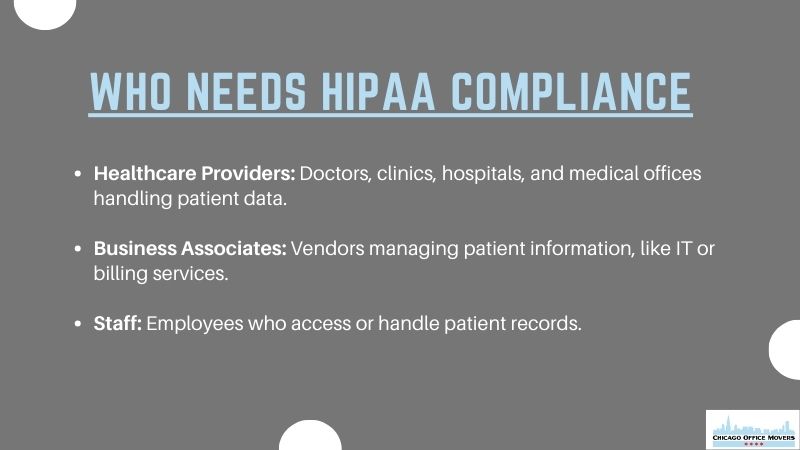
who needs HIPAA Compliance

When relocating a medical practice, keeping patient information safe is non-negotiable. Chicago practices face unique challenges during a move, and following proper HIPAA procedures is essential to avoid costly fines and protect trust. Here’s what it takes:

  • Encrypt ePHI During Transport and Storage: Any electronic protected health information (ePHI) should be encrypted while being moved or stored. This ensures that, even if devices or drives are lost or temporarily misplaced, patient data remains secure.
  • Use Multi-Factor Authentication (MFA): Accessing ePHI should require MFA on computers, servers, and mobile devices. This extra layer of security helps prevent unauthorized access during the busy and sometimes chaotic moving process.
  • Perform Security Risk Assessments: Conduct thorough checks of your systems and processes before and after the move. Identify weak points in IT networks, data handling, and storage procedures so you can address vulnerabilities before they become problems.
  • Verify Business Associate Agreements: Any third-party movers, IT specialists, or vendors handling sensitive records must have HIPAA-compliant agreements in place. This ensures that everyone involved meets federal standards for protecting patient information.

By following these key steps, your practice can prevent serious HIPAA violations. Fines for non-compliance can range from $100 to $50,000 per violation, depending on intent and severity. Taking proactive measures not only helps your practice stay within legal requirements but also reassures patients that their confidential information is managed with the utmost care throughout the relocation.

How to Keep Patients Informed and Maintain HIPAA Compliance

A smooth relocation isn’t just about moving equipment and furniture — it’s also about keeping your patients informed while protecting their sensitive information. Chicago practices can follow these steps to maintain trust and security:

Communicate Professionally:

  •       Send emails, text messages, or postcards to notify patients of the new address, phone numbers, and office hours.
  •       Update your website, voicemail, and Google Business profile to reflect the change.
  •       Avoid sharing any patient-specific health information in public communications.

Conduct a Post-Move HIPAA Review:

  •       Revisit your HIPAA Security Risk Assessment to ensure all safeguards are active.
  •       Confirm that physical security measures — including locks, alarms, and access controls — are functioning correctly.
  •       Provide staff with training on location-specific procedures or updates to data handling protocols.

Relocate Your Practice with Chicago Office Movers

Relocating a medical practice takes thorough planning and flawless execution. While a challenge, the move is less overwhelming when doctors work with an experienced commercial mover that provides expert assistance throughout the entire process, from planning to careful packing and secure transport.

Chicago Office Movers is the preferred choice for large corporations and small businesses with plans to move to greener pastures. We provide comprehensive commercial moving services, designed to support companies and allow them to reach their next destination as seamlessly as possible.

Our crews are background checked, licensed, and trained to handle moves of all sizes. We successfully pack and transport fragile lab equipment and heavy machinery. Movers treat all items with care, ensuring they arrive at the destination in the same condition as when they were packed.

Medical practices can be assured that their most sensitive goods, such as medical record files, are handled securely and confidentially. We also offer storage facilities when you need to store items prior to the move. At the destination, our movers provide setup services.

Reduce your downtime and stress by hiring the experienced relocation professionals at Chicago Office Movers. Our office moving company will relocate your medical practice, whether it’s down the street or across the ocean. Plus, our expertise and industry knowledge allow us to resolve issues right away.

Frequently Asked Questions


Yes. Accounting software like QuickBooks or Xero can help track expenses, while project management tools such as Asana or Trello can manage timelines and tasks. Energy monitoring systems or IT tracking tools can also identify areas where hidden costs may occur.

Not always. Standard business insurance may not cover losses during transit or temporary storage. Check with your provider and consider supplemental coverage for sensitive equipment, inventory, or critical documents.

Sometimes renting coworking spaces or temporary offices is cheaper than delaying operations. Consider this option if your new office isn’t fully ready for move-in.

Contact Us

  • This field is for validation purposes and should be left unchanged.
  • MM slash DD slash YYYY
How to Safely Pack Fragile Office Items for a Move

How to Safely Pack Fragile Office Items for a Move

How to Safely Pack Fragile Office Items for a Move

Office relocations require careful planning, especially when moving fragile office items. Whether you’re relocating glass-topped tables, sensitive electronics, or valuable artwork, proper packing is essential for minimizing the risk of damage during the move. Here’s a guide on how to pack delicate office equipment and furniture for a safe and efficient office relocation.

What are Fragile Office Items?

Anything described as fragile can be easily broken or damaged. Offices contain an abundance of fragile goods and equipment. The conference room may contain glass-topped tables, and the management offices may be furnished with glass-topped desks—all of which are extremely fragile.

Today’s offices operate on complex electronic systems. When relocating, it’s necessary to pack up sensitive tech equipment, such as computers, monitors, and printers. Fragile items like these can be damaged by the impact if dropped during the moving process.

Offices with sophisticated designs may need to move marble or stone worktops. These fragile goods should be handled with special care to prevent damage. Similarly, framed artwork and antiques that decorate offices require careful packing to remain in pristine condition.

Packing Fragile Office Items: Step-by-Step Guide

Preparing for a relocation means it’s necessary to pack up the whole office. While employees can pack their own belongings and contribute to packing the rest of the office, it requires time during working hours. Conversely, let professional movers handle the packing to save time.

1. Packing Glass Tables

When opting for DIY packing, disassemble glass tabletops. Remove the legs and dismantle the fragile glass frames. Pack these components separately. When unscrewing the table legs, drop the screws into a sealable plastic bag and tape it to the table so it does not become lost during the move.

Wrap the glass top with packing paper. Secure the paper with tape but be sure to prevent the adhesive from coming into contact with the glass. Next, cover the tabletop with bubble wrap, with the bubbles facing inward. Place the wrapped glass into a specialty telescopic box for maximum protection.

2. Packing Tech Equipment

Sensitive electronics should be packed with care to streamline the reinstallation process at the new office. Before packing, back up all important files to an external hard drive or cloud-based storage to prevent data loss. Also take photos of the setup, which can be invaluable during reassembly.

Disassemble and label cables and cords. Box the devices in the original packaging, when possible, which is designed to provide optimal protection. Wrap the tech in bubble wrap and place them in boxes with cushioning. Pack keyboards and mice in smaller boxes or bags to maintain organization.

Utilize anti-static bubble wrap for packing the electronics. If the original boxes are unavailable, select sturdy, corrugated boxes to pack the equipment. Choose boxes that are slightly larger than the devices to allow room for protective padding, such as packing peanuts.

3. Packing Office Artwork and Antiques

Office artwork and antiques are vulnerable to the bumps and jostles of the moving process. Appraise the valuables prior to packing them, in case they are damaged during the relocation. Avoid wrapping wooden antiques in bubble wrap, since multiple layers can damage the porous wood surface.

Secure fragile parts, such as drawers or doors, but avoid using tape to do so. Cover the antiques with moving blankets, which can keep these parts securely closed. Next, add padding to the outside of the moving blankets. Remove any small pieces and store them carefully.

4.Marble-top Tables

Marble is a heavy material but can be easily damaged during a move. Protect these fragile goods by wrapping them in moving blankets. Ensure the blankets cover the pieces from the top and wrap around the bottom. A wardrobe box can be effectively used to further protect the marble.

Upon purchasing a special carton or crate to house the marble components during the relocation, pack no more than one marble piece inside. Keep the carton or crate upright and never lay it flat while storing or moving it. Clearly mark the carton as fragile.

Tips for Packing Fragile Office Items

When packing fragile office items, bear in mind a few general strategies:

  • Use Strong, New Boxes: Always choose new, sturdy boxes designed for office moves. Avoid old, flimsy boxes that can collapse under pressure.
  • Separate Items: Avoid packing fragile items together to reduce the risk of breakage. Use bubble wrap and packing paper to cushion each item.
  • Label Boxes: Clearly mark all boxes containing fragile items to alert movers. You can also color code the boxes for a better organization.

3 Materials You Can Use To Keep The Office Fragile Items Safe

When preparing for an office relocation, using the right packing materials can make all the difference in keeping your fragile items intact. Whether you're moving high-end tech, delicate décor, or glass furnishings, these three materials are the go-to choices for protecting your office essentials during transport.

Top 3 Packing Materials to Protect Fragile Office Items

Bubble Wrap:

Bubble wrap is a must-have when it comes to safeguarding breakable office items. Its air-filled pockets provide a cushioned barrier that helps absorb shocks and vibrations during loading, transport, and unloading. This makes it especially effective for wrapping fragile objects like monitors, computer towers, glass table tops, and framed artwork.

How to Use It:

  • For best results, wrap the item completely with the bubble wrap, ensuring the bubbles face inward to protect the surface.
  • Secure the wrap with tape, but avoid taping directly onto the item itself.
  • When packing multiple items, stack them carefully and add extra layers of bubble wrap between each item to prevent shifting during the move.

Packing Paper:

Unlike newspaper, which can leave ink stains, packing paper is clean, pliable, and safe for delicate surfaces. It’s ideal for wrapping smaller items, filling in gaps inside boxes, or layering between stacked pieces to prevent scratches. Glassware, ceramics, and decorative office pieces benefit from being individually wrapped in packing paper to avoid direct contact with other items.

How to Use It:

  • Roll individual items, such as glassware and small office décor, in several layers of packing paper to ensure they are fully cushioned.
  • Use packing paper to fill any empty spaces in boxes, ensuring items don't shift during transport.
  • For larger, more fragile items, use the paper as a cushion around the item and layer it with bubble wrap for added protection.

Sturdy Corrugated Boxes:

Using high-quality, corrugated cardboard boxes is essential when transporting fragile office goods. These boxes provide structural strength and help distribute weight evenly, reducing the risk of contents being crushed. Double-walled boxes offer even greater protection for heavier or more delicate items.

How to Use It:

  • Choose boxes that are slightly larger than the items you're packing to allow for protective padding, such as bubble wrap or packing paper, around the contents.
  • For heavier items, like monitors or printers, use double-walled boxes for extra strength. For fragile items like glass or ceramics, use specialized boxes designed for these goods.
  • Label the boxes clearly as "Fragile" to ensure they are handled with care during the move.
  • To prevent crushing, pack the heaviest items at the bottom of the box and lighter, more fragile items on top.

Professional Office Movers that can Safely Handle Fragile Items

Safely packing fragile office goods for a move can be accomplished with the right skills and packing supplies. When your team is busy preparing for the relocation, save valuable time by delegating the packing and unpacking to the experienced commercial movers at Chicago Office Movers.

Our moving crews are equipped with sturdy boxes and packing supplies as well as expertise to safely pack your entire office. Whether you are moving precious antiques, sensitive IT servers, or other specialty items, we pack your possessions carefully to prevent the risk of damage during the corporate relocation.

As a part of our expert packing services, we label boxes to ensure proper placement at the new office. You receive a full inventory of all goods packed. The items are packed in boxes and crates guaranteed to protect the contents. Plus, our crews unpack your items at the destination.

Our corporate moving services include additional conveniences, such as short- and long-term storage in our secure facilities. We offer insurance and service contracts. Moving crews are licensed, trained, and background-checked to give customers maximum confidence that their goods are in secure hands.

Whether you plan to move your company locally, long-distance or internationally, choose Chicago Office Movers for safe packing and seamless relocation. Call our Elk Grove Village, Illinois, office today for a free estimate and assign your corporate relocation to Chicagoland’s most trusted office mover.


Frequently Asked Questions


When packing delicate office lighting fixtures, first remove any bulbs and secure them separately. Wrap the light fixtures in bubble wrap or moving blankets, making sure to cushion the bulbs and other fragile parts. Place the wrapped lighting in a box that’s slightly larger than the item to allow room for protective padding. Label the box as fragile.

While it’s tempting to reuse old boxes, it’s better to use new, sturdy boxes for fragile items. Old boxes may have weakened over time and could fail to protect delicate items. If you must reuse boxes, make sure they are still in good condition with no tears, dents, or weak spots.

When packing office shelving units or bookshelves, remove all items from the shelves and disassemble any removable parts. Wrap individual shelves in bubble wrap or moving blankets and pack them separately. If the shelving unit is too large, protect it with moving blankets and ensure it is secured upright during the move.

Contact Us

  • This field is for validation purposes and should be left unchanged.
  • MM slash DD slash YYYY
how to unpack after moving to your new office

How to Unpack After Moving to Your New Office: A Step-by-Step Guide


how to unpack after moving to your new office

The new office is impressive and the staff are excited to begin work. Everything is proceeding well—except the mountainous boxes piled up in nearly every square inch of space are intimidating. Rather than be overwhelmed, use these tips to unpack with ease after a relocation.

Jumpstarting on work projects in the new location is impossible without unpacking the essentials, from technology that streamlines tasks to important paperwork. The work mounts and the employees grow increasingly frustrated without knowing where to start with the unpacking process.

Fortunately, unpacking after moving to a new office can be accomplished with minimal stress. Organization is key during the unpacking efforts, as it allows for a more organized workflow once complete. Breaking up the unpacking into smaller chunks also makes the process manageable.

1. Take Inventory

Accounting for all the office possessions is the first step in the unpacking process. Check the inventory list the moving company provides to ensure all the items are delivered. This should be done as soon as possible after arriving so that corrections can be made and mistakes fixed.

Do a headcount of all major office goods, such as desks, chairs, equipment, and filing cabinets. Communicate with office personnel to confirm they have received the boxes necessary to perform work tasks. If necessary, open the boxes to verify the contents.

2. Arrange Furniture

Ideally, the layout in the new office will be established prior to relocating. If not, scope out the new space, which will have different configurations than the old one. Arrange the desks and chairs to create a growth-oriented, dynamic office environment the staff will appreciate.

Factor in work zones, such as specific areas for collaborations and others for individual workstations. Balance personal and collaborative workspaces for a more productive work environment. Maintain an open flow through the office and maximize natural lighting when arranging desks and cubicles.

3. Set up Technology

Setting up the technology is also preferably done prior to arriving at the new office. IT staff should have access to the building to set up servers and wireless networks. Once the desks and monitors arrive, IT personnel run the cables, implement security measures and validate the IT systems.

The office’s IT teams should manage the computer cables to reduce tripping hazards and maintain the visual aesthetics at individual workstations. Effective cable management, though a mundane task, optimizes the functionality of the network infrastructure and promotes smooth network operations.

4. Unpack the Essentials First

Once the critical technology (monitors, mice, and keyboards) is unpacked, the less-important files and office supplies should be removed from their boxes. Rarely used office goods, such as reference books, can be left in their respective boxes and unpacked leisurely.

Advise each employee to unpack their boxes and containers at their workstations rather than delegate the unpacking to other staff. Office workers best understand how they’d like to utilize their given space. The responsibility of general unpacking, however, can be shared amongst employees.

5. Unpack Right Away

The longer the boxes sit in the new office location, the longer the company downtime will be. Unpack as soon as possible after relocating to minimize downtime. If unpacking requires a bigger investment in time than is practical, unpack a few boxes each day until the task is done.

A time-saving convenience many offices take advantage of is the unpacking services corporate movers provide. Once at the destination, the moving crews unpack boxes, install equipment, and reassemble furniture, such as large conference desks. They also provide initial packing services for added ease.

6. Encourage Staff Input

Once the office is unpacked, ask the employees for their input. Any suggestions they make to their individual workstation setups or the office in general can increase productivity, promote comfort, and create an efficient work environment. Staff also feel valued and part of the change.

Remember that once equipment is in place and the supplies are in their containers, the office setup can be modified as work needs change. Employees may find a different workstation configuration better suits their needs. Or an office bookshelf may be more suitable elsewhere.

7. Take Time to Adjust

It may take a few weeks for the team to adjust to the new location once unpacked. Allow ample time for employees to settle in and give them opportunities to make tweaks as they see fit. Remember that the new office layout should evolve with the company as needs change.

Teams may expand over time as the company grows. Furniture may need to be rearranged or equipment upgraded as priorities shift. In general, however, it’s important that the workspace remains functional as soon as the office goods are unpacked as well as anytime needs change.

To make your office move even smoother, check out [What to Pack First During an Office Move] for helpful tips on tackling the initial packing phase efficiently.

Top Commercial Movers in Chicago and the Suburbs for a Smooth Office Relocation

While relocating to a new office is an exciting event, the packing process is often stressful. Chicago Office Movers takes the stress out of your move with a comprehensive range of services designed to streamline your corporate relocation and prevent unnecessary angst.

commercial movers helping with the corporate relocation process and set up

Our licensed and insured commercial movers are experts at packing offices of any size. We successfully pack a range of items, from fragile artwork to bulky machinery. Plus, our crews are background-checked to assure our valued customers that their goods are in secure hands throughout their corporate move.

We are also available to unpack your office goods at the new location. Our packing services minimize overall moving time as well as corporate downtime. You receive a full inventory of all items packed so you can quickly account for all your belongings.

Additional conveniences offered include short- and long-term storage options, insurance and service contracts and professional assistance with planning the relocation. Since we specialize in commercial moves, our specialists can provide you with expert tips to ensure a seamless office relocation.

Whether you intend to move IT systems, science labs, or cubicles, Chicago Office Movers is prepared to help you pack and relocate with ease. We are available to relocate your company locally, long-distance or internationally. Call our Elk Grove Village, Illinois, office for a free estimate today at 312-244-2246 !

Contact Us

  • This field is for validation purposes and should be left unchanged.
  • MM slash DD slash YYYY
top-amenities-employees-want-in-the-office

Top Amenities Employees Want in the Office

top-amenities-employees-want-in-the-office

Enhancing morale and improving productivity are two important reasons to add desirable amenities to the workplace. But it’s crucial to find amenities that truly promote wellness rather than distract employees. Here are the top amenities staff want in the office.

Most offices are equipped with standard desks and chairs. These basics allow employees to perform their tasks. While standard equipment is necessary, offices that go above and beyond with extras, like snacks, a gym, pet-friendly areas, or optimum lighting, improve their staff’s overall work experience.

The best amenities not only improve employees’ physical comfort but create an enjoyable workspace. The management shows they genuinely care about the well-being of their team. As a result, employees are happier, more productive and motivated to carry out the company’s vision.

What are the top amenities office employees want?

1. Physical Amenities

Desirable amenities focus on improving certain aspects of employees’ work life. Amenities that promote physical well-being include ergonomic chairs and desks or an onsite gym where staff can exercise to stay fit. Amenities like these are designed to keep staff physically healthy.

In addition to ergonomic furniture that prevents issues from sitting for prolong periods, physical comfort amenities include healthy snacks in the break room or cafeteria. Personal lockers are also included in this category, as they help keep employees’ valuables safe and organized.

Onsite health services are another top amenity employees seek in an office. Easy access to screenings and wellness programs helps staff detect health issues early on. By contributing to their physical wellness, onsite health programs prevent workers from getting sick and taking time off.

top-amenities-employees-love-in-office-checklist

2. Emotional Amenities

Natural lighting is known for its mood-enhancing effects. Employees desire natural lighting for its numerous health benefits, such as reduced eye strain, fewer headaches, and less drowsiness. Staff make less mistakes, too, when they work in spaces with ample natural lighting.

Wellness rooms are likewise highly coveted. When ridden with stress or anxiety, staff have the opportunity to escape from the office chaos and into a wellness room for much-needed relaxation. The wellness room provides a calm, quiet environment and a break from the hustle and bustle.

3. Convenient Amenities

Working parents especially value office amenities that deliver convenience. With onsite childcare, staff are free to invest in work projects, knowing their children are nearby, safe, and cared for. Employees who take advantage of this amenity show increased productivity and less stress.

A shuttle or transportation service to and from a public rail or bus station makes a major difference in the satisfaction of employees who utilize public transportation. Not only does a shuttle service improve punctuality, but it adds a cost-savings measure for parking-related expenses.

Furthermore, a company that offers a shuttle service showcases their commitment to environmental sustainability, a major attraction for highly skilled talent. By reducing the number of cars on the road with a reliable transportation service, the company lowers their carbon footprint.

A furry friend is an instant mood-booster, reducing stress, anxiety, and depression. Employees who are allowed to bring their pets to the workplace continue experiencing their uplifted mood while engaged in projects. Pet-friendly zones at work are appreciated by pet owners.

4. Social Amenities

Connecting with colleagues is equally important for employee satisfaction at work. Opportunities for connection happen when companies designate spaces that encourage teamwork and collaboration. Collaborative workspaces and areas where employees can gather are two examples of highly sought-after social amenities.

By providing a place for colleagues to unwind or take breaks, companies foster a positive workplace environment where increased teamwork and engagement are the norm. Collaborative areas also allow for better problem-solving, information sharing, and trust-building. A sense of belonging develops among the team.

5. Technology Amenities

Today’s fast-paced companies rely heavily on technology. It’s no surprise employees value it, too. The latest technology empowers team members and allows them to communicate and collaborate no matter where they are located, whether onsite or working remotely. Improved data security is an additional benefit.

Work processes are streamlined with advanced technology. Automation tools, for instance, prevent staff from engaging in repetitive tasks while also reducing human error, saving the company time and money. Streamlined workflow processes provide greater flexibility and improve the staff’s quality of work.

Favored amenities increase employee satisfaction and retention. Companies that provide desirable amenities show that they are committed to promoting the well-being of their office staff. Plus, by adding top amenities, companies enhance their corporate reputation and attract highly talented workforces.

Drawing prospective talent and ensuring the satisfaction of existing ones are key reasons companies are urged to include the most desirable amenities in their office. Companies that experience space limitations, such as when adding a gym, might consider relocating to a larger office.

Professional Commercial Movers

When your company is looking to move to greener pastures, you’ll need a reliable commercial mover on your side. Chicago Office Movers is equipped with the dedicated moving crews, equipment, and experience to ensure your corporate relocation is as seamless as possible.

Our move counselors are available to help you plan your office relocation from start to finish. Moving crews can pack and unpack your office goods. Our movers are background-checked, licensed, and trained—so you can be assured that your valuables are in secure hands.

We offer several conveniences to add ease to your move. Short- and long-term storage options are available in our secure facilities. Movers are experienced in safely relocating a wide range of office goods, such as bulky furniture, sensitive IT systems, fragile electronics, and cubicles.

Your goods are loaded into our climate-controlled moving trucks featuring lift gates and air-ride suspensions to add a further layer of protection to your office items. Our corporate customers receive up-to-date tracking information, whether their goods are in our storage facility or trucks.

Give your employees the amenities they deserve. Relocate locally, long-distance, or internationally with the help of Chicago Office Movers. We’re among the most trusted office moving companies in Chicagoland. Call our Elk Grove Village, Illinois, office today to receive a free estimate.

Contact Us

  • This field is for validation purposes and should be left unchanged.
  • MM slash DD slash YYYY
Call us (312) 244-2246