



How Hard Is It to Relocate a Business?

Relocating a business is harder than most companies expect, and the difficulty rarely comes from the obvious things. The packing, the trucks, the physical move itself, and that part is usually fine. What catches businesses off guard is everything around it: the IT coordination that falls through, the lease timing that creates a two-month overlap, the employees who quietly start looking for other jobs when the commute gets longer.
For a small office of 10 to 15 people moving within the same city, a relocation is demanding but manageable. For a company with 50 or more employees, specialized equipment, or a complicated lease situation, it becomes one of the more involved operational projects a business will take on. How hard it is depends almost entirely on how early you start planning and how clearly the responsibilities are divided before anything gets packed.
The Part That Disrupts Business Most: Operations Going Dark
The single most damaging outcome in any office relocation is downtime, which is the period when your team cannot work because systems are being moved, internet is not yet active, or workstations are still in boxes.
Most businesses underestimate how long this window actually is. They plan for a weekend move and assume everything will be running by Monday morning. What they do not account for is that the internet provider needs 5 to 10 business days of lead time to activate a new line at the new address. Or that the server room cannot be reconnected until the IT vendor comes on-site, which may not be until Tuesday. Or that 15 workstations need to be individually set up and tested before anyone can log in.
Businesses that move without disruption treat the technology activation timeline as the anchor for everything else. They confirm internet provisioning dates first, then schedule the physical move around it. They do not move equipment until they know exactly who is reconnecting it and when. That sequence matters more than almost anything else in the planning process.
IT and Technology: Where Most Moves Break Down
Technology is where most office relocations get into trouble, because the complexity is easy to underestimate and the consequences of getting it wrong are immediate.
Moving desktop computers and monitors is a physical task. Moving a server room, a VoIP phone system, a network switch infrastructure, or industry-specific hardware is a coordinated technical project. These are not the same thing.
Before the move begins, every business should have clear written answers to the following questions. Who is physically transporting the servers, and are those machines under a maintenance or warranty contract that restricts third-party handling? Who is responsible for decommissioning the old network setup and building the new one? What is the confirmed activation date for internet and phone service at the new address? If that date slips, what is the backup plan?
The moving company handles the physical transport. Your IT team or managed service provider handles the technical reconnection. Your telecom and internet vendors handle the line activation. All three need to be confirmed and coordinated before move week, not during it. If you want a structured way to manage this, our IT office move checklist covers each of these coordination points in order.
Lease Timing Creates Pressure That Is Hard to Control
The lease situation at both locations is one of the few parts of an office relocation that is largely outside your control, which is exactly what makes it stressful.
On the old space, you may have a fixed end date with a restoration clause that requires you to return the space to its original condition before handing back the keys. Depending on how the office was built out over the years, that can be a real cost. On the new space, possession dates slip. Construction or prior tenant delays push your move-in date back, and your old lease does not automatically extend to accommodate it.
The result is that many businesses end up paying rent on two locations at once for a month or more. This is common enough that it should be budgeted for from the start, not treated as an unexpected cost when it happens.
The other lease issue that creates problems is underestimating how long the restoration and move-out process takes at the old address. Companies often plan their move-out date right up against the lease end date, leaving no time to handle furniture disposal, patch walls, or deal with anything that comes up. Building in at least two weeks between move-out and lease end date is a reasonable buffer.
Employees Notice How a Relocation Is Handled
Office relocations are watched closely by employees, and how leadership communicates about the move shapes how people feel about the company in ways that outlast the move itself.
The concerns employees have are practical. How does the new location affect the commute? Is parking available and at what cost? Will desk assignments change? What happens to the coffee setup? These feel like small things to leadership and like very real daily concerns to the people who have to live with them.
The mistake companies make is communicating too late or too vaguely. Announcing a move two weeks before it happens, with no detail about the new location or what the transition will look like, creates anxiety. Employees fill the information gap with their own assumptions, and those assumptions are rarely optimistic.
Companies that handle this well start communicating early, share specific information about the new space, and acknowledge openly that there will be an adjustment period. They do not oversell the new office as an exciting upgrade if employees are losing a shorter commute. Honest and specific is always better than enthusiastic and vague. For a practical approach to this, see our guide on how to prepare your employees for an office relocation.
Budget Overruns Are the Rule, Not the Exception
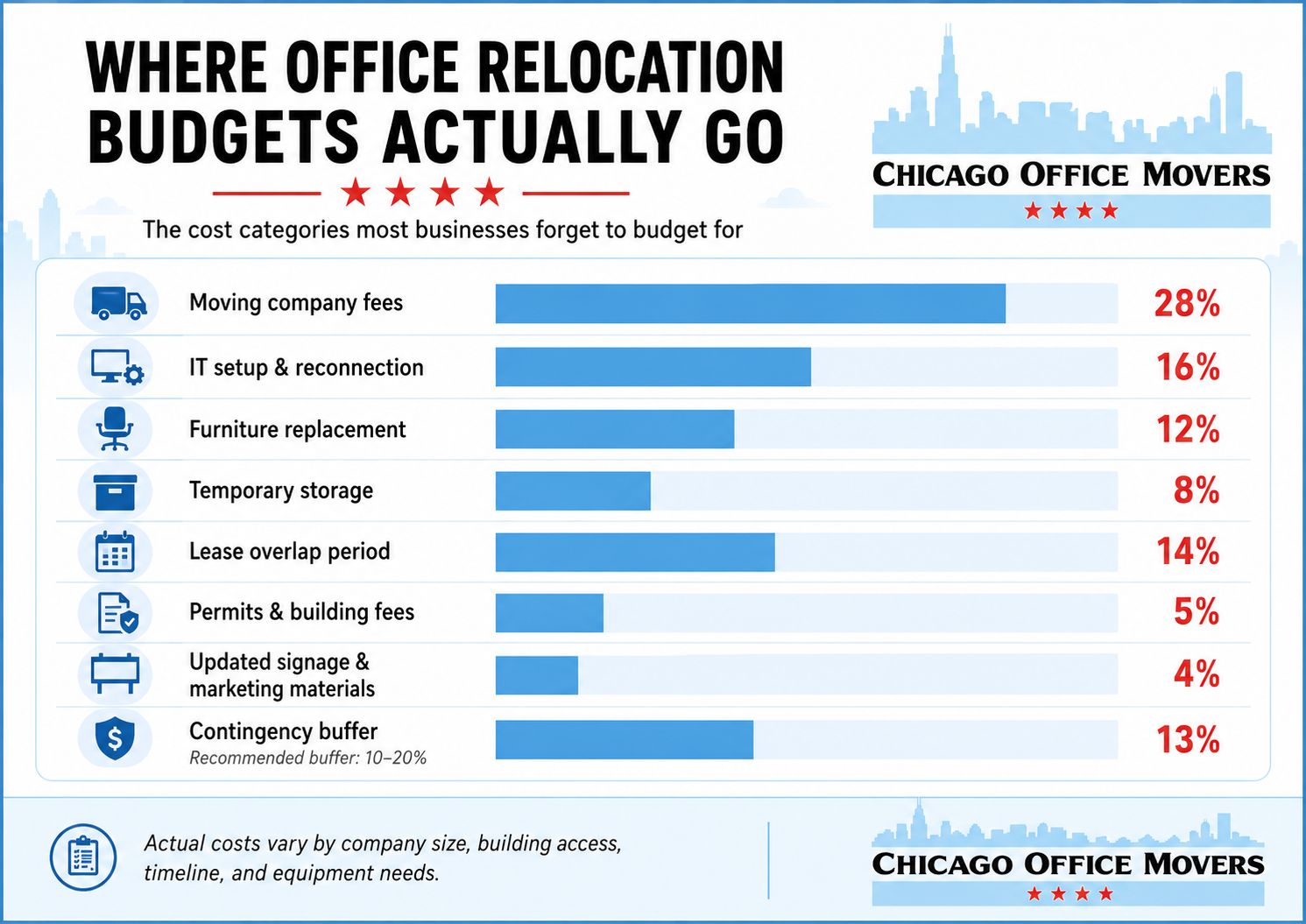
Almost every office relocation costs more than the original estimate. This is not usually because the commercial moving company changes its quote. It is because the first budget rarely captures everything that has a cost.
The categories that most commonly get missed are furniture replacement (pieces that do not fit the new layout or are in worse condition than realized), disposal fees for items left behind, temporary storage if the move-in date and move-out date do not line up, IT installation labor at the new space, signage at the new address, and small-but-real costs like new keys, parking validations, and updated marketing materials with the new address.
A realistic moving budget includes a contingency of 10 to 20 percent above the line-item total. Most businesses that skip the contingency end up spending it anyway; they just do it reactively instead of planned.
What Makes a Business Relocation Harder Than Average
A few specific factors consistently push a relocation from manageable to difficult.
Compressed timelines. Companies that begin planning 60 days or less before the move date are working in a hole from the start. Vendor lead times, internet provisioning, building access coordination, and employee communication all require more runway than that. Twelve to sixteen weeks is a more realistic planning horizon for a mid-size office.
Specialized or regulated equipment. Medical practices, labs, manufacturing companies, and businesses with heavy production equipment are dealing with a different level of complexity than a standard office. Some equipment requires certified riggers. Some has environmental or calibration requirements that affect how and when it can be moved. This needs to be scoped with the moving company well before the move date.
No internal project owner. Relocations that have no single internal point of accountability consistently underperform. When the move is shared across an office manager, an IT coordinator, and a facilities contact with no clear lead, decisions slow down, vendors get mixed signals, and things fall through the gaps. One person needs to own the project timeline and have authority to make calls.
Building constraints at either location. Loading dock hours, freight elevator availability, building management requirements around move times, and parking restrictions for large trucks can significantly affect how the move day runs. These details need to be confirmed with both buildings before the date is locked in. In Chicago specifically, moving trucks parking on city streets during a commercial relocation may require a permit from the city. This is an easy thing to overlook and an expensive problem on move day if it comes up. Our post on permits needed to relocate a business in Chicago covers what is typically required and how to get ahead of it.
What a Well-Run Office Relocation Actually Looks Like
A well-run business relocation looks boring from the outside. The trucks show up, the move happens over the planned window, the team comes in Monday and gets to work. What makes that happen is a significant amount of coordination that was completed in the weeks before move day.
The internet and phone vendors were confirmed six weeks out. The IT team had a written reconnection plan. The building managers at both locations were briefed on the truck access requirements. Employees received a detailed communication timeline with specific answers to the questions they actually care about. The moving company did a proper walkthrough of both spaces before providing a quote, not just a square footage estimate over the phone.
None of that is complicated. But all of it requires starting early enough to do it properly.
Call Chicago Office Movers If You're Moving Your Business
If you are planning an office move in Chicago or the surrounding area and want to understand exactly what the process involves for your specific situation, Chicago Office Movers can walk you through it. We have handled commercial relocations for companies across a range of industries and sizes, and we can give you a realistic picture of what your move requires before you commit to a timeline. Get in touch to schedule a consultation.

Director of Marketing & Development
Office: (847) 621-5176
Cell: (312) 497-3203
At Chicago Office Movers, Kari-Ann is our Director of Marketing & Development. As the master of visibility, she is responsible for all things Branding and Marketing related. Kari-Ann comes to us with experiences in Marketing for a multi-brand and multi-location company, the service industry, non profit marketing event planning and fundraising, and retail management. She is the Chair of the Board for the Schaumburg Business Association 2021 & 2022, a member of the Elk Grove Village Chamber Board of Directors, and past chair and top fundraiser for the Northwest Suburban Walk To End Alzheimer’s.
Kari-Ann received her Bachelor of Business Administration in Marketing from Western Michigan University. She is Master Certified in Constant Contact Email Marketing and has held numerous social media training classes.
Tags: Business Relocation, office moving tips