



Chicago High-Rise Office Moving Guide: Requirements, Checklist & Planning Tips
Moving into a Chicago high-rise office requires more coordination than a typical commercial move. Before moving day, your business may need to reserve a freight elevator, schedule loading dock access, provide a certificate of insurance (COI), obtain building management approval, coordinate security access, verify truck parking, and work within strict move-in hours.
The most important rule is simple: confirm your building's moving requirements before scheduling the final move date. Rules can vary significantly between downtown Chicago office towers, even when the buildings are only a few blocks apart.
Chicago Office Movers regularly handles the logistics involved in commercial relocations, including move management, furniture disassembly and reassembly, IT and server-room relocations, and moves involving union properties.
Chicago High-Rise Office Moving Checklist
Before moving into a Chicago high-rise, confirm these items:
- Contact building or property management
- Get the building's move-in requirements in writing
- Reserve the freight elevator
- Reserve the loading dock or service entrance
- Confirm permitted moving dates and hours
- Obtain the required certificate of insurance
- Verify truck size and loading restrictions
- Determine whether parking or curb permits are needed
- Confirm security and contractor check-in procedures
- Ask whether union labor is required
- Measure elevator doors, elevator cabs, hallways and suite entrances
- Measure oversized office furniture
- Coordinate furniture disassembly if needed
- Schedule IT shutdown and restart
- Confirm floor, wall and elevator protection requirements
- Create a move-day access plan
- Give your moving company the building manager's contact information
Why Is Moving Into a Chicago High-Rise Different From a Regular Office Move?
The biggest challenge with a high-rise office move usually isn't transporting the furniture. It's working around everything the building controls.
A suburban office move may allow a moving truck to pull close to an entrance while crews work relatively freely. In a downtown Chicago high-rise, movers may instead have to coordinate around:
- Shared freight elevators
- Limited loading dock space
- Other tenant moves
- Deliveries and contractors
- Building security
- Restricted moving hours
- Service corridors
- Elevator weight and size limits
- Lobby restrictions
- Floor and wall protection requirements
A loading dock may only accommodate one or two trucks at a time. Security may require the names of every crew member before they arrive. Some properties only permit major moves during evenings or weekends.
Even the route between the loading dock and your office suite can affect the moving plan.
Is Your Chicago Office Building a Union Building?
Some downtown Chicago properties require union labor for certain moving work.
Ask building management about union requirements before selecting or scheduling a moving company. The requirement can affect which crews are permitted to work inside the property and how the move must be scheduled.
Chicago Office Movers is a member of Teamsters Local 705 and can handle relocations in properties where union moving labor is required.
Do You Need to Reserve a Freight Elevator for a Chicago Office Move?
In many Chicago high-rise buildings, yes. Tenants are commonly required to reserve a freight elevator for a move, and some properties restrict furniture and moving equipment from passenger elevators. Freight elevators are better suited for office relocations because they typically offer:
- Larger elevator cabs
- Wider doors
- Higher weight capacities
- Protective padding
- Access to service corridors
- Better access to loading areas
Reservations are generally handled through building or property management. A commercial moving company providing move management can often help coordinate the process.
What Should You Ask Before Reserving a Freight Elevator?
Ask building management:
- How far in advance does the freight elevator need to be reserved?
- What moving hours are available?
- Is the elevator dedicated to our move?
- Will it be shared with other tenants?
- What are the cab dimensions?
- What is the elevator's weight capacity?
- What is the width and height of the elevator door?
- Is elevator padding required?
- Who provides the padding?
- Is floor protection required?
- What happens if the move exceeds the reserved time?
- What is the contingency plan if the elevator is unavailable?
How Does Loading Dock Access Work for a Chicago High-Rise Move?
Loading dock access can be one of the biggest logistical constraints during a downtown Chicago office move.
Before scheduling trucks, confirm:
- Whether the building has a dedicated loading dock
- Whether dock reservations are required
- How long a truck can remain in the dock
- Maximum truck length
- Maximum vehicle height
- Dock clearance
- Whether a liftgate is necessary
- Loading dock operating hours
- Whether dock staff must be present
- Where additional moving trucks can stage
Not every Chicago high-rise has a traditional loading dock. Some buildings use an alley service entrance. Others rely on a designated loading area or another approved access point.
If there is no dedicated loading dock, the move may require a longer carry between the truck and freight elevator, which can affect labor needs, crew size and the amount of time required for the move.
Do You Need a Certificate of Insurance for a Chicago Office Move?
Many commercial office buildings require a moving company to provide a certificate of insurance, commonly called a COI, before movers are permitted to enter the property.
Requirements differ by building, so obtain the exact insurance specifications directly from property management.
A moving-company COI commonly documents coverage such as:
- General liability
- Automobile liability
- Workers' compensation
- Umbrella or excess liability when required
The building may also require specific parties to be listed as additional insureds.
Who Provides the COI?
The moving company's insurance carrier or broker normally prepares the certificate based on the building's requirements.
When Should You Submit the COI?
Submit it as early as practical after receiving the property's requirements. Some buildings require insurance documentation well before move day.
What Can Go Wrong With a COI?
One of the most common issues is not simply forgetting the certificate. It is submitting a COI with:
- The wrong legal entity
- Incorrect additional insured wording
- Insufficient coverage limits
- Incorrect property information
- Expired coverage
Ask building management for its exact requirements and, when available, a sample certificate.
A missing or incorrect COI can delay approval for freight elevator or loading dock access.
What Should You Ask the Building Manager Before an Office Move?
Before finalizing your moving date, ask:
- What dates and hours are moves permitted?
- Are weekend moves allowed?
- Are after-hours moves required?
- Are there after-hours building fees?
- Do we need to reserve a freight elevator?
- How long can we reserve the elevator?
- Is a certificate of insurance required?
- What insurance limits are required?
- Who needs to be listed as an additional insured?
- Is a loading dock available?
- How long can a truck remain in the loading dock?
- Are there restrictions on truck height or length?
- Are there move-in fees or deposits?
- Does security need a moving crew list?
- What identification do movers need?
- Is floor or wall protection required?
- Are there restrictions on using the lobby?
- Is union labor required?
- Where can moving trucks stage?
- Who is the building contact on move day?
Also request the move-day contact's direct phone number. If an access issue occurs during an evening or weekend move, a direct building contact can be much more useful than a general property-management number.
What Is a High-Rise Office Move Window?
A move window is the period during which a building permits moving activity. For example, an office tower may allow moves:
- After regular business hours
- During designated evening hours
- On Saturdays
- On Sundays
- During specific loading-dock windows
Buildings establish move windows to reduce interference with employees, visitors, deliveries and other tenants.
Are Weekend Office Moves Better?
Not necessarily. Weekend moves can reduce interference with employees, but they may also involve:
- Additional building fees
- Reduced building staff
- Special security arrangements
- Limited freight elevator availability
- Different loading dock procedures
The best schedule depends on the building, freight elevator availability, downtown traffic, the size of the relocation and how much business downtime you can tolerate.
Where Can Moving Trucks Park During a Downtown Chicago Office Move?
Do not assume a commercial moving truck can park directly outside your building.
Downtown Chicago curb space can be restricted, metered, signed or otherwise unavailable. Depending on the property, moving trucks may need to use:
- A loading dock
- Alley access
- A service drive
- An approved loading zone
- Reserved curb space
Some moves may require permits or other arrangements when public curb space, sidewalks or the public right-of-way are involved.
Because City of Chicago permitting requirements and fees can change, verify current requirements with the appropriate city department, 311, building management or your commercial moving company before move day.
What Security Information Is Needed Before Moving Into a High-Rise?
Properties with controlled access may require moving-company and vehicle information before move day. Be prepared to provide:
- Moving company name
- Crew member names
- Driver information
- Truck information
- Moving date
- Approved moving hours
- Freight elevator reservation
- Loading dock reservation
- Tenant contact information
- Required insurance documents
On moving day, crews may need to check in with building security, provide identification and use designated service entrances or access cards.
After-hours moves may have additional procedures, so confirm them before the crew arrives.
Measure the Freight Elevator and Furniture Before Moving Day
A desk fitting inside your current office doesn't mean it will fit through the elevator doors at your new building. Before moving day, measure:
- Freight elevator door
- Freight elevator cab
- Suite entrance
- Building doors
- Service corridors
- Hallways
- Tight corners
- Stairways
Then measure large office items, including:
- Conference tables
- Reception desks
- Executive desks
- Large file cabinets
- Server racks
- Storage cabinets
- Modular workstations
If an item cannot pass through the planned route, possible solutions include disassembly, using another access route, temporarily storing the item or replacing it.
Large conference tables and reception desks frequently require special planning because they may originally have been assembled inside the office.
Read our guide to furniture disassembly before an office move
How Should IT Be Coordinated During a High-Rise Office Move?
IT relocation needs to follow the same master schedule as the movers and building.
Computers, servers, network equipment, printers, monitors and phones have to be disconnected, transported and restarted in an order that minimizes business disruption.
A common problem is a mismatch between the IT schedule and building access.
For example, if your IT team cannot shut down critical systems until 6:00 p.m., but the moving company's dock access ends at 8:00 p.m., the available relocation window becomes extremely tight.
Your:
- Moving company
- IT provider
- Building manager
- Internal move coordinator
should all work from the same timeline.
For larger technology relocations, see our server room and data center relocation services.
Chicago High-Rise Office Move Timeline
2–4 Weeks Before the Move
Contact property management for both buildings and confirm move requirements.
Complete items such as:
- COI submission
- Freight elevator reservation
- Loading dock reservation
- Moving-hour approval
- Building fees
- Union requirements
- Parking and truck access
- Security procedures
For larger or more complicated relocations, begin planning earlier.
1 Week Before the Move
Finalize:
- Moving crew
- Truck schedule
- Furniture inventory
- Office floor plan
- Employee communication
- Security list
- Dock arrangements
- IT schedule
- Furniture labels
Label furniture, workstations and boxes according to the new floor plan.
Moving Day
The moving crew should:
- Check in with building security.
- Confirm dock or curb access.
- Install required floor, wall and elevator protection.
- Confirm the freight elevator.
- Load and transport office contents.
- Deliver items according to the floor plan.
- Reassemble designated furniture.
A company representative should remain available throughout the relocation in case the building or moving crew needs an immediate decision.
After the Move
Complete:
- Furniture reassembly
- IT restart
- Workstation setup
- Removal of packing materials
- Damage inspection
- Old-office walkthrough
- Final landlord requirements
Common Chicago High-Rise Moving Problems and How to Prevent Them
| Problem | How to Prevent It |
|---|---|
| Freight elevator wasn't reserved | Reserve it as soon as the move date is approved and get confirmation in writing. |
| COI is incorrect | Obtain the building's exact insurance requirements before requesting the certificate. |
| Moving truck cannot access the dock | Confirm truck length, height, and dock restrictions beforehand. |
| Furniture doesn't fit in the elevator | Measure the elevator door and oversized furniture before moving day. |
| Move is scheduled outside approved hours | Verify permitted moving hours before booking the move. |
| Security doesn't have the crew list | Submit mover and vehicle information in advance. |
| Move exceeds the reserved window | Build crew size and truck scheduling around the available access time. |
| IT isn't ready when movers arrive | Create one coordinated moving and technology schedule. |
| Building requires union labor | Verify labor requirements before hiring the moving company. |
Chicago High-Rise Office Move Requirements
| Requirement | Why It Matters | Who to Contact |
|---|---|---|
| Freight elevator | Controls movement between floors | Building management |
| Loading dock | Determines truck access | Property management |
| COI | May be required before movers receive access | Building + moving company |
| Move window | Determines when relocation work can occur | Building management |
| Security | Controls vendor and crew access | Building security |
| Parking/loading | Determines where moving trucks can stop | Building / applicable city authority |
| Furniture dimensions | Prevents access problems | Moving company |
| IT schedule | Helps reduce downtime | IT team + movers |
| Union requirements | Determines permitted moving labor | Property management |
High-Rise Office Moving in the Loop, River North, West Loop and Downtown Chicago
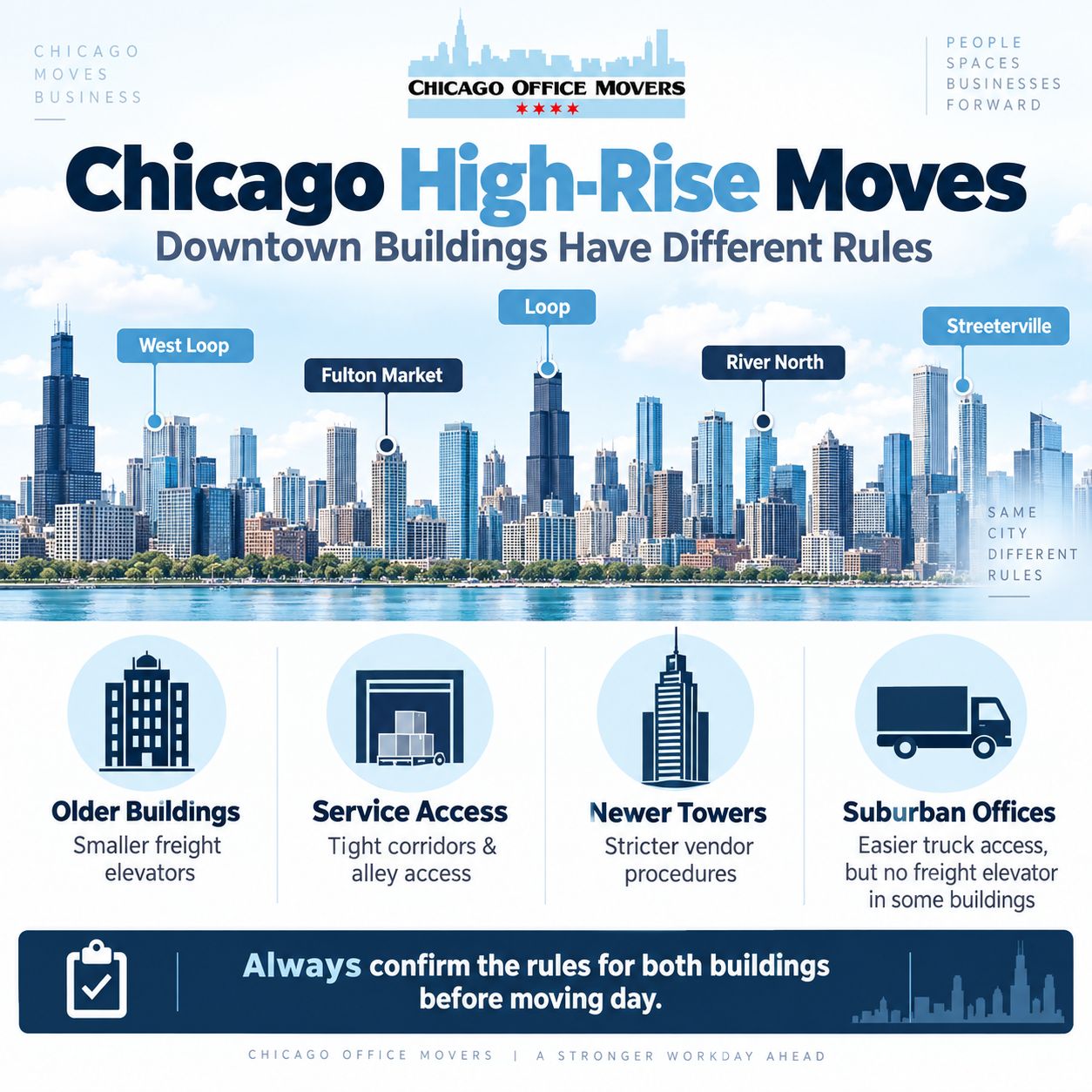
Office-moving requirements can vary throughout the Loop, River North, West Loop, Fulton Market, Streeterville and other downtown Chicago business districts.
Older office buildings may have smaller freight elevators, narrow service corridors or limited alley access. Newer towers may have detailed vendor procedures, dedicated loading schedules or stricter building-access rules.
Suburban office buildings can present a different set of challenges. Truck access may be easier, but some properties do not have freight elevators or formal loading docks.
There is no universal Chicago high-rise moving policy.
Always confirm the requirements for the specific property you're moving into and the building you're leaving.
Chicago High-Rise Office Moving FAQs
How far in advance should I schedule a Chicago high-rise office move?
For many office relocations, beginning planning approximately four to eight weeks ahead provides time to coordinate building requirements, movers, IT and employees. Larger relocations or buildings with limited moving windows may require significantly more lead time.
Do I need to reserve a freight elevator for an office move?
Many Chicago high-rise buildings require freight elevator reservations. Contact property management as soon as the moving date is being considered.
Do Chicago office buildings require a certificate of insurance?
Many commercial properties require a COI from the moving company, but coverage requirements vary by property. Ask building management for the exact limits and additional insured wording.
Can an office move take place on a weekend?
Often, but the building must allow it. Weekend or after-hours moves can require additional security arrangements, fees or building approval.
Can a moving truck park directly outside a Chicago high-rise?
Not necessarily. Depending on the property, movers may use a loading dock, alley, service entrance or approved curb space. Confirm truck access before move day.
What happens if office furniture doesn't fit in the freight elevator?
The moving company may need to disassemble the furniture, find another approved route, temporarily store it or discuss replacement options. Measuring large items and elevator openings beforehand helps avoid that decision on moving day.
What does building management typically need before an office move?
Requirements vary, but commonly requested information includes the moving date, approved moving window, moving-company information, COI, freight-elevator reservation, dock arrangements, crew information and a tenant contact.
How long does a Chicago high-rise office move take?
The timeline depends on the size of the office, number of floors, elevator availability, loading restrictions, furniture requirements and IT needs. Some smaller or mid-sized relocations can be completed within one approved evening or weekend move window, while larger projects may require multiple phases.
What if the building doesn't have a loading dock?
Movers may use an approved service entrance, alley or other loading location. A longer carry between the truck and building can require additional labor and time.
Can commercial movers work after normal business hours?
Yes. Some downtown buildings actually prefer or require substantial moving activity to occur after normal tenant hours.
Who reserves the freight elevator?
The tenant is generally responsible for complying with building requirements, although a commercial moving company providing move management can help coordinate reservations with property management.
How do I know whether my Chicago office building requires union movers?
Ask the building manager or property-management company directly. Determine labor requirements before hiring and scheduling your movers.
Planning a Move Into or Out of a Chicago High-Rise?
A successful Chicago high-rise office move starts with the building requirements, not the moving truck.
Before finalizing the move date, confirm:
- Freight elevator access
- Loading dock access
- Move-in hours
- COI requirements
- Security procedures
- Truck access
- Union requirements
- Building protection requirements
- Parking or permitting requirements
Once those details are confirmed, your moving company can build a realistic plan around the available building window, including crews, trucks, furniture handling, IT coordination and delivery sequencing.
Chicago Office Movers provides commercial move management, furniture disassembly and reassembly, server and data center relocation and moving services for union properties.