

How to Choose a Heavy Equipment Moving Company in Chicago
How to Choose a Heavy Equipment Moving Company in Chicago
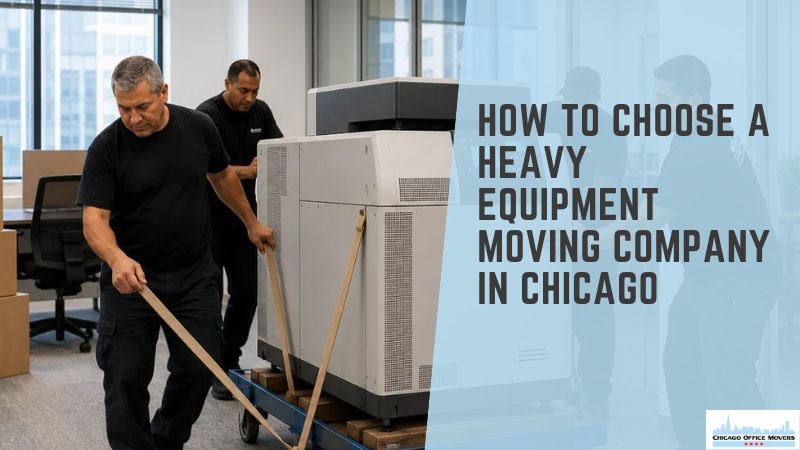
Choosing a heavy equipment moving company in Chicago takes more than comparing quotes. Moving industrial machinery requires proven rigging experience, specialized equipment, proper insurance and licensing, and a thorough understanding of the job site before work begins. Without those qualifications, even a straightforward move can put your equipment, facility, and schedule at risk.
Chicago Office Movers brings trained, certified crews and the right equipment to handle machinery moves throughout the Chicago area, whether you're relocating a single machine or an entire assembly line.
This guide explains what to look for in a qualified mover, which questions to ask before hiring, what affects the cost, and which red flags to avoid. For advice on preparing for the move itself, see our tips to safely move heavy machinery.
What Makes a Heavy Equipment Moving Company Reliable?
A reliable heavy equipment mover should be able to demonstrate five essential qualifications. Don't just take a company's word for it. Ask for documentation and specific examples that show it has the experience, equipment, and credentials to handle your move safely.
- Rigging experience: Lifting a machine off its anchors, rotating it through a doorway, and setting it down level is a different skill from carrying desks. Ask who on the crew plans the lift and how long they've done it.
- Own the proper equipment: Gantries, forklifts, machine skates, toe jacks, and air-ride trailers should come from the mover's own yard.
- Hold the right licenses: Look for a USDOT number and Illinois Commerce Commission authority, then check both. The USDOT number can be looked up for free on the FMCSA website.
- Crews are trained and certified: Ask about safety training, OSHA compliance, and industry credentials such as IOMI certification.
- Experience moving equipment like yours: A mover with a long record on printing presses may never have handled an injection molding machine or a medical imaging unit. Ask for two or three commercial references from similar jobs.
What Types of Heavy Equipment Can Professional Movers Relocate?
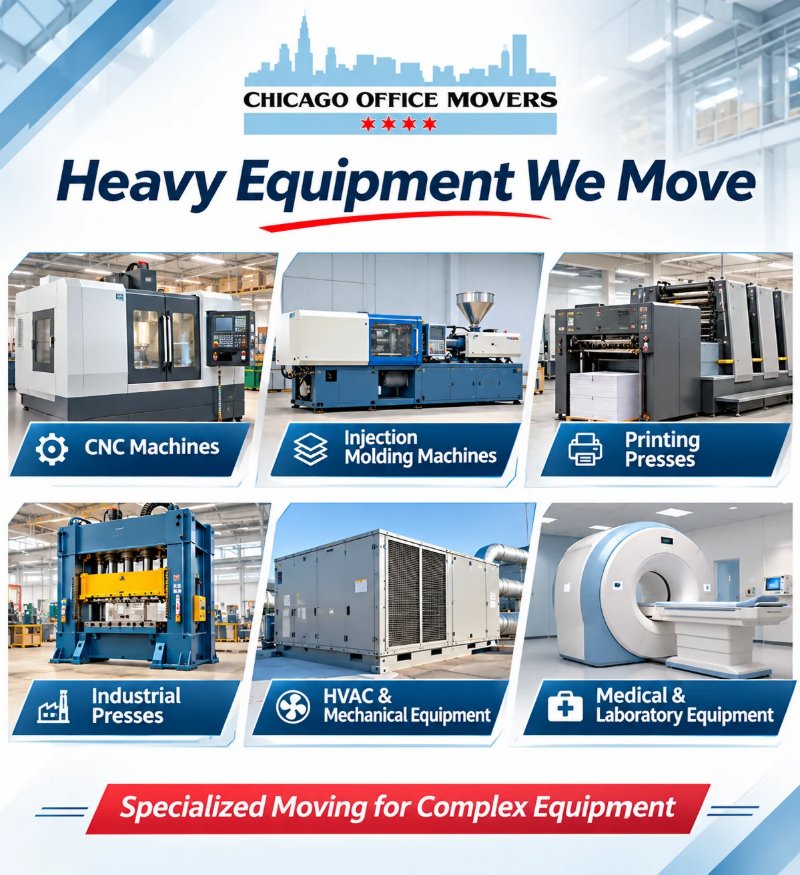
Industrial machinery movers handle a wide range of equipment used in manufacturing, commercial facilities, healthcare, and other specialized environments. The equipment involved determines the lifting method, transportation requirements, crew size, and preparation needed before moving day.
Common types of machinery and heavy equipment include:
- CNC machines and machining centers: Computer-controlled manufacturing equipment that often requires careful leveling and positioning at the new facility.
- Injection molding machines: Heavy industrial machines used in plastic manufacturing that may require specialized rigging and transportation equipment.
- Printing presses: Large commercial printing equipment that can involve partial disassembly, careful handling of sensitive components, and precise reinstallation.
- Industrial presses and production machinery: Equipment used in manufacturing and assembly operations, including machines that are part of a larger production line.
- HVAC and commercial mechanical equipment: Large heating, ventilation, and cooling units that may require forklifts, cranes, or specialized lifting systems.
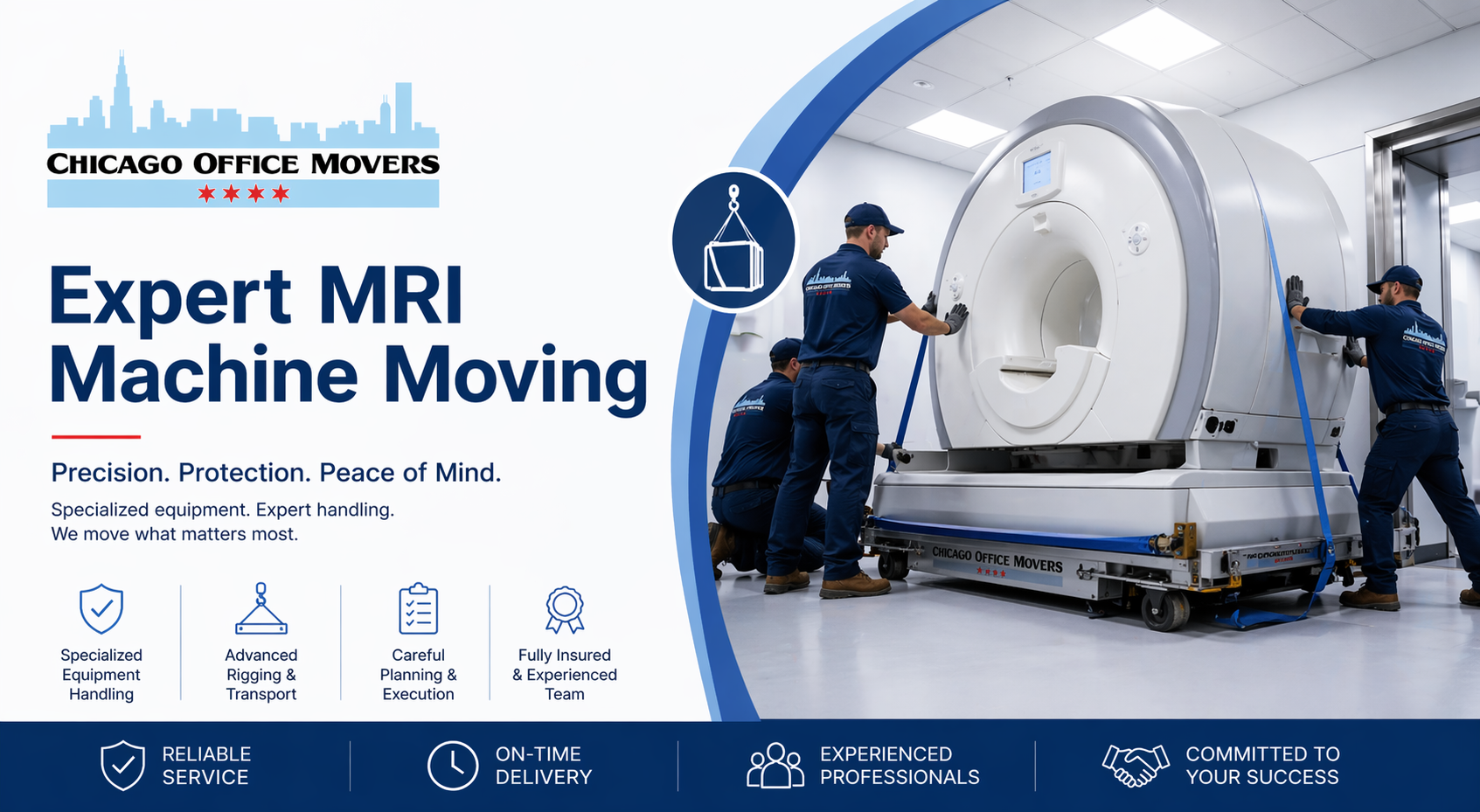
- Medical and laboratory equipment: Sensitive machines that require additional attention to handling, positioning, and transportation conditions.
Before hiring a mover, provide the machine's dimensions, approximate weight, manufacturer, and model number whenever possible. Photographs and equipment specifications also help the moving company determine which rigging methods and transportation equipment will be needed.
What Insurance and Documents Should Heavy Equipment Movers Provide?
Before comparing quotes, verify that each mover has the proper insurance and documentation. These aren't details to sort out after you've chosen a company. If a mover can't provide proof of coverage and the required credentials, cross them off your list. Three documents are especially important.
- General liability coverage pays for damage to the building such as a cracked lobby floor, a gouged freight elevator, a dock door hit by a forklift.
- Cargo coverage pays for damage to the equipment itself while it's in the mover's care. Ask for the limit and compare it with what your machine would cost to replace.
- Workers' compensation covers the crew. Without it, an injury on your property can become your problem.
Your building will probably want a certificate of insurance (COI) as well. Property managers in Chicago commonly require one before they approve a move, and they often set minimum coverage limits and exact wording for the certificate holder.
You must also settle the question of who pays if something gets damaged? A mover's standard liability is often based on weight, and for a dense, expensive machine, that can fall well short of replacement value. Ask about declared value or full-value options, check whether your own business policy covers equipment in transit, and get the answer in writing. A condition report with photos before and after the move makes any claim much easier to resolve.
5 Questions to Ask Before Hiring Machinery Movers
Once you've narrowed your options, ask each company the same five questions. Comparing their answers side by side will help you see which movers have the experience, resources, and planning process your job requires.
- Have you moved this type of equipment before? A good answer names specific machines and offers a reference. A vague "we move everything" tells you nothing.
- Will you do an on-site survey? The answer should be yes, at both locations. The estimator needs to measure doorways, check floor conditions, and see the dock.
- Who handles disconnect and reconnect? Find out whether the mover disassembles, reconnects, levels, and anchors the machine, or whether you need your own electrician, millwright, or the manufacturer's technician.
- Do you handle permits and building coordination? Someone has to reserve the freight elevator, send the COI, and pull any street or oversize-load permits. Determine whether that's the mover’s responsibility or yours.
- Are your crews in-house or subcontracted? Subcontracting isn't automatically bad, but you should know who will be in your building and whose insurance covers them.
How Much Does Heavy Equipment Moving Cost?
Seven key factors influence the cost of a heavy equipment move, from the machine's size and weight to the conditions at each location. Because every job has different requirements, an accurate quote starts with an on-site assessment. A reliable mover will survey the equipment and the route before putting a price on the job.
- Weight and dimensions: Heavier and larger machines need bigger equipment, more crew, and sometimes partial disassembly to fit through the building.
- Access: Stairs, narrow corridors, freight elevator weight limits, and the height of the loading dock all change the plan.
- Distance: A move across the building, across Chicago, or to another state each carries different truck time and fuel costs.
- Rigging needs: A machine that rolls out on skates costs less to move than one that has to be lifted with a gantry or hoisted through an opening.
- After-hours work: Many buildings only allow machinery moves on evenings or weekends, which can mean overtime rates.
- Permits: Oversize or overweight loads and reserved street space may require permits, with fees and lead time attached.
- Storage: If the new space isn't ready, the equipment needs somewhere to wait, ideally a climate-controlled warehouse.
Factor downtime into your comparison as well. A mover with a higher quote may still be the more cost-effective choice if they get your production line back up and running two days sooner.
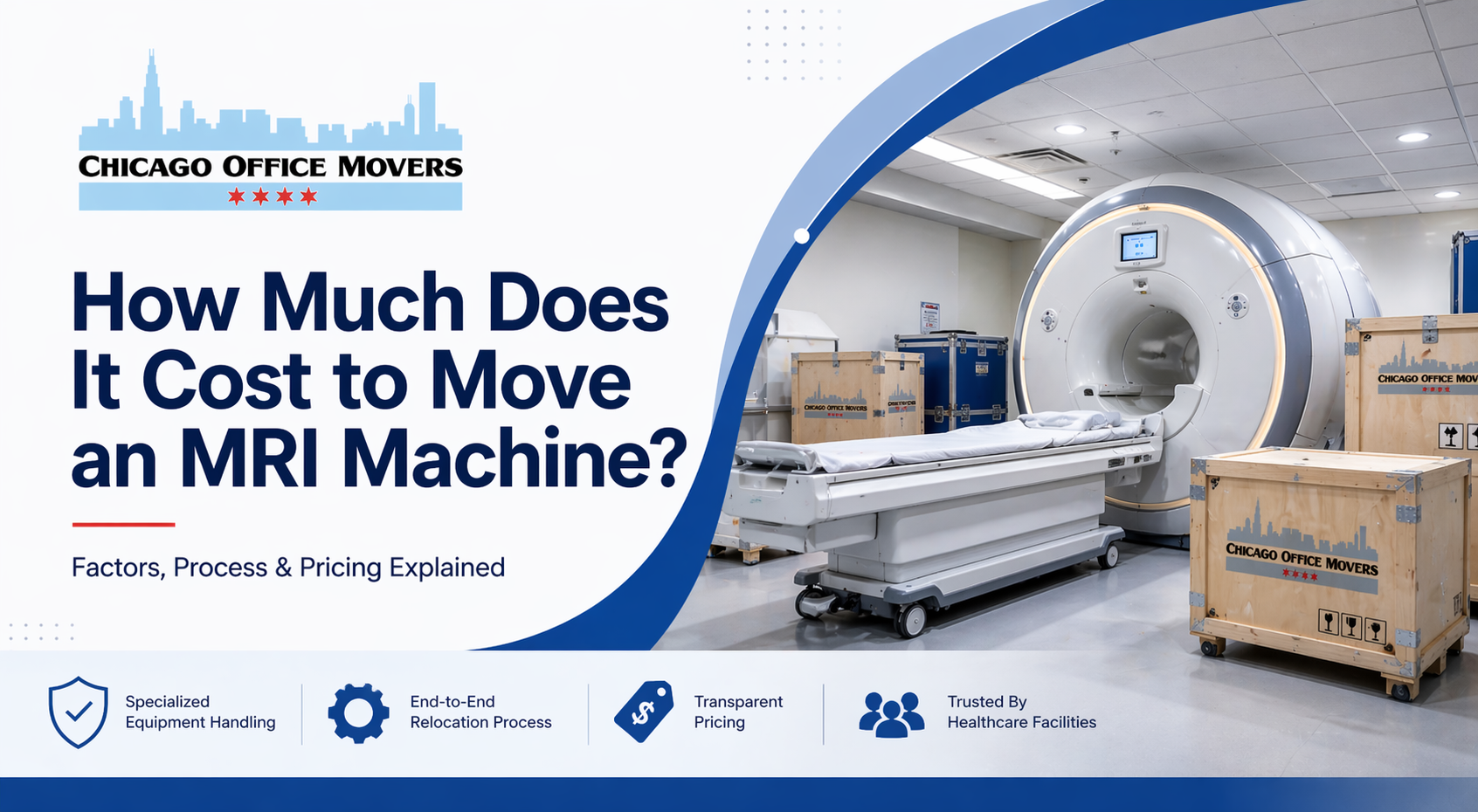
Moving specialized medical equipment can involve additional costs depending on its size, weight, sensitivity, and handling requirements. For a closer look at these expenses, read our guide to the cost of moving an MRI machine.
Comparing Heavy Equipment Moving Companies and Quotes
When comparing heavy equipment moving quotes, look beyond the bottom-line price. The details matter just as much as the total.
Start by requesting an itemized quote from each company. Labor, equipment, rigging, trucking, permits, crating, and storage should be listed separately so you can see what each charge covers.
Next, check that every quote covers the same scope of work. If one includes disconnecting, reconnecting, and leveling machinery while another only covers transport to the loading dock, you're not comparing equivalent services. Give each mover the same equipment list, site details, and building requirements so they can price the same job.
Finally, review the exclusions carefully. Pay attention to electrical work, equipment anchoring, floor protection, waiting time, overtime, and permit fees. Exclusions aren't necessarily a dealbreaker, but you should know what's not included before moving day rather than discovering it when the bill arrives.
Warning Signs to Watch for When Hiring Heavy Equipment Movers
Watch for these six warning signs as you evaluate potential movers. One should give you pause; multiple red flags are a strong reason to take your business elsewhere.
- No site visit: Nobody can plan a machinery move from a description.
- A quote over the phone only: If there's nothing in writing, there's nothing to hold the mover to.
- No proof of insurance: A legitimate mover can send a COI within a day or two.
- A big upfront deposit: Large cash deposits before any work happens are a common pattern in moving scams.
- No commercial references: Residential reviews don't tell you how a company handles a production floor.
- A price far below the others: The low bidder is usually missing something: insurance, equipment, crew size, or part of the scope.
Challenges of Moving Heavy Equipment in Chicago
In Chicago, building requirements often determine the moving schedule, so choose a company familiar with how downtown properties operate.
Loop high-rises typically require freight elevator reservations, and the best time slots fill quickly. Most buildings limit heavy moves to evenings or weekends, and each freight elevator has a weight capacity that determines whether a machine can move in one piece or must be broken down into sections.
Building rules add another layer of planning. Expect requirements for a COI, floor and wall protection, dock scheduling, and sometimes union labor. Some Chicago buildings only allow union crews, which eliminates any mover that can't meet that requirement. Our Chicago high-rise office moving guide covers these requirements in more detail.
Street access matters, too. Many older buildings lack an off-street loading dock, meaning the truck needs reserved curb space. Securing that space requires a city permit and advance signage.
Winter adds its own challenges. Snow and ice can slow dock operations, while cold temperatures can affect hydraulics and sensitive electronics. For moves scheduled between December and March, build a backup date into the plan and ask how the mover protects equipment from cold and moisture.
Heavy Equipment Moving Services in Chicago: Why Choose Chicago Office Movers?
Chicago Office Movers has the experience, equipment, and credentials this guide recommends. Here's how our qualifications measure up, with details you can verify before making your decision.
- Experience: Our team has more than 150 years of combined moving experience, and we move everything from a single machine to a full assembly line. That includes CNC machines, injection molding equipment, printing presses, HVAC units, and medical machines.
- Trained, certified union crews: Our movers are IOMI-certified members of Teamsters Local 705, so we can work in union-only buildings. Our processes are designed to meet or exceed OSHA requirements.
- Licensing you can look up: We operate under US DOT 2889377 and IL C.C. MC 216511.
- Full-service machinery work: We disassemble, move, and reassemble equipment, then reconnect, level, align, and anchor it at the new location.
- Permits and logistics handled: We take care of permits, route planning, and coordination with building management and city departments.
- Protection and documentation: We use air-ride trailers, custom crating, and padding, and we provide a condition report before and after the move.
- Storage when you need it: Equipment can wait in our climate-controlled warehouse until your new space is ready.
We maintain an A+ rating with the Better Business Bureau and serve Chicago businesses from two locations in Elk Grove Village and River North.
To learn more about our machinery moving services in Chicago, call Chicago Office Movers at 312-244-2246. We can schedule a site survey, assess your moving requirements, and provide a free estimate.
Heavy Equipment Moving FAQs
How much does it cost to hire heavy equipment movers?
There's no flat rate. The price depends on the equipment's weight and dimensions, access at both buildings, distance, rigging requirements, timing, permits, and any storage. A mover needs to see the equipment and the route before giving a number you can rely on. Chicago Office Movers provides free estimates for machinery moves in the Chicago area.
What's the difference between a rigger and a mover?
A rigger lifts, lowers, and positions heavy loads using gear such as gantries, hoists, jacks, and skates, and works out how the load will be supported. A mover packs, loads, and transports. Heavy equipment jobs usually need both skill sets, so ask whether one company supplies both or brings in a rigging subcontractor.
Do I need a certificate of insurance for my building?
Almost always in a commercial building, and especially in downtown Chicago high-rises. Property managers typically require a COI from the mover before they'll reserve the dock or freight elevator, and many specify coverage limits and the exact wording for the certificate holder.
How far in advance should I book?
For a single machine in a ground-level space, a few weeks is often enough. For multiple machines, a high-rise, or a move that needs permits or after-hours building access, start two to three months out.
Do movers handle disconnecting and reconnecting machinery?
Some do and some don't, so get it in writing. Chicago Office Movers can disassemble, move, and reassemble machinery, and can reconnect, level, align, and anchor equipment at the new location. Hard-wired electrical, gas, or plumbing connections may require a licensed trade, so confirm who is responsible for each connection.

Senior Move Consultant | Chicago Office Movers
Vic Rothstein is a Senior Move Consultant with Chicago Office Movers, bringing decades of experience in commercial moving, logistics, and relocation planning. With a career spanning thousands of successful moves, Vic helps businesses navigate office relocations with careful planning, efficient execution, and minimal disruption.
Vic’s experience began on the moving crew, giving him a hands-on understanding of every aspect of the relocation process. Over the years, he progressed into leadership roles managing complex commercial projects, coordinating teams, improving operations, and overseeing large-scale moves.
Before joining Chicago Office Movers, Vic spent more than 35 years at Anderson Movers, where he developed extensive expertise in commercial relocations, packing, transportation, fleet management, and client coordination. His ability to anticipate challenges and create organized moving strategies helps businesses transition smoothly from one location to another.
A lifelong Chicago Northwest Side resident, Vic combines deep local knowledge with his background in construction and logistics to provide businesses with practical solutions for their relocation needs.
Through the Chicago Office Movers blog, Vic shares insights on office relocations, workplace planning, commercial moving strategies, and tips to help businesses complete their moves efficiently and successfully.